Learning journey
A clearer learning flow.
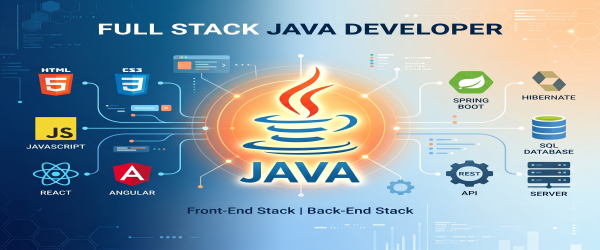
The progression begins with Core Java, OOP, and data structures, advances through frontend development with HTML/CSS/JavaScript and React, moves into backend mastery with Spring Boot, Spring MVC, Spring Security, Hibernate and JPA, and RESTful API design, covers relational and NoSQL databases with MySQL and MongoDB, and finishes with microservices, Docker, Kubernetes, CI/CD with Jenkins, AWS cloud deployment, and a production-grade full stack capstone. [web:627]
Phase 01 — Backend Core
Core Java, OOP, DSA & Git
Java syntax, data types, and control flow; Object-Oriented Programming — encapsulation, inheritance, polymorphism, and abstraction; interfaces, abstract classes, and generics; Java Collections Framework — List, Set, Map, Queue, and Deque; exception handling; file I/O and serialisation; multithreading and concurrency — Thread, Runnable, synchronized, and ExecutorService; Java 8+ features — Streams, Lambda expressions, Optional, and method references; data structures and algorithms essentials; Git and GitHub — branching, merge, rebase, pull requests, and GitHub Actions. [web:633]
Phase 02 — Frontend
HTML/CSS, JavaScript & React
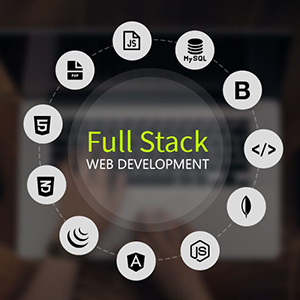
HTML5 semantics and accessibility; CSS3 — Flexbox, Grid, responsive design, and media queries; JavaScript ES6+ — closures, promises, async/await, and event loop; TypeScript fundamentals; React — components, JSX, props, state, hooks (useState, useEffect, useContext), React Router, and Axios for API calls; state management with Redux Toolkit or Zustand; RESTful API consumption from the frontend; form handling and validation; and deploying React applications with Vite and Vercel. [web:626]
Phase 03 — Backend Pro
Spring Boot, Spring MVC, Spring Security & REST APIs
Spring Framework — IoC container, dependency injection, and bean lifecycle; Spring Boot — auto-configuration, starter dependencies, and Spring Boot Actuator; Spring MVC — DispatcherServlet, controllers, and view resolvers; RESTful API design — HTTP methods, status codes, versioning, pagination, and HATEOAS; Spring Security — authentication, authorisation, JWT token implementation, and OAuth2 basics; Hibernate and JPA — entity mapping, relationships (OneToMany, ManyToMany), JPQL, named queries, and N+1 problem resolution; and Maven and Gradle build tools. [web:622]
Phase 04 — Data
MySQL, MongoDB & Database Design
Relational database design — normalisation (1NF, 2NF, 3NF), ER diagrams, and schema design; MySQL — DDL/DML, joins, subqueries, indexes, stored procedures, and transactions (ACID); Spring Data JPA — repository pattern, derived query methods, and @Query; MongoDB — document model, collections, CRUD with Spring Data MongoDB, aggregation pipeline, and indexing; database connection pooling with HikariCP; Redis caching fundamentals; and SQL query optimisation and EXPLAIN plan analysis. [web:630]
Phase 05 — DevOps, Cloud & Capstone
Microservices, Docker, Kubernetes, Jenkins, AWS & Capstone
Microservices architecture — decomposition patterns, API gateway with Spring Cloud Gateway, service discovery with Eureka, and inter-service communication with Feign; Docker — Dockerfile, images, containers, Docker Compose, and multi-stage builds; Kubernetes basics — Pods, Deployments, Services, and ConfigMaps; CI/CD pipeline with Jenkins — build, test, and deploy automation; AWS deployment — EC2, S3, RDS, and Elastic Beanstalk; unit and integration testing with JUnit 5 and Mockito; Swagger/OpenAPI documentation; Agile/Scrum methodology; and a production-grade Java full stack capstone deployed on AWS. [web:624]