All Courses

Master Artificial Intelligence & Machine Learning with Real-World Applications

Insta InfoTech® presents an advanced AI & Machine Learning course for students and professionals. Learn the fundamentals of AI, machine learning algorithms, and deep learning architectures.

Gain expertise in Python, TensorFlow, Keras, and Scikit-Learn for model building. Explore real-world applications in Natural Language Processing (NLP), Computer Vision, and Predictive Analytics. Develop AI-driven solutions with hands-on projects and industry case studies.


AI & Machine Learning

AI & Machine Learning

Master the complete AI and Machine Learning stack — from Python and mathematics foundations through supervised and unsupervised learning, into deep neural networks with TensorFlow and PyTorch, NLP, computer vision, generative AI, and MLOps deployment — building production-grade intelligent systems that power recommendation engines, image classifiers, language models, and autonomous decision-making applications used across every industry.

Certificate
You will get Medhavi Skills Certificate
Partnership
Insta Infotech × Medhavi Skills University
Recognition
NCrF aligned learning pathway
AI & ML intelligence stack
Python, Maths & Classical ML
NumPy, pandas, sklearn, regression, SVM, ensembles
Learn
 
Deep Learning — CNNs, RNNs & Transformers
TensorFlow, PyTorch, NLP, computer vision, LLMs
Build
 
Generative AI, MLOps & Deployment
GANs, RAG, LLM fine-tuning, model APIs, and CI/CD
Deploy

Learn, build, and deploy — every AI concept taught through a real model that runs, predicts, and ships.

 
Program overview

More than fitting a model and calling it AI.

This course treats AI and Machine Learning as an engineering discipline, not a black box. Students build from Python and mathematical foundations through every classical ML algorithm, into the architecture of deep neural networks, and finally to the cutting edge — transformers, large language models, generative AI, and the MLOps pipeline that takes a trained model from notebook to production API — all grounded in real datasets and real business problems.

01 / Build, train, and evaluate
Every model runs on real data.

Every algorithm — from linear regression to transformer attention — is implemented, trained, and evaluated on real datasets. You understand the maths, write the code, measure the results, and improve the model.

02 / Think in model architecture
Why this layer? Why this loss?

Understand the design decisions behind neural network architectures — why CNNs use convolutions for images, why RNNs and LSTMs handle sequences, why attention mechanisms in transformers outperform both — and apply that reasoning to choose the right model for any problem.

03 / Career signal
Portfolio and interview prep

Build and present trained ML models, deep learning projects, and a generative AI capstone — interview-ready for ML engineer, AI developer, data scientist, NLP engineer, and computer vision roles across product, research, and enterprise AI teams.

 
Learning journey

A clearer learning flow.

The progression builds from Python, maths, and EDA, through classical ML algorithms, into deep learning architectures, NLP and computer vision, and finishes with generative AI, LLM applications, MLOps, and a full-scale AI capstone project.

Step 01
Python, Maths & EDA
Python for AI — NumPy, pandas, matplotlib, seaborn; linear algebra, probability, statistics; exploratory data analysis, feature engineering, and data preprocessing.
Step 02
Classical Machine Learning
Supervised — linear/logistic regression, decision trees, SVM, random forests, XGBoost; unsupervised — k-means, hierarchical clustering, PCA; model evaluation, cross-validation, and hyperparameter tuning with scikit-learn.
Step 03
Deep Learning — Neural Networks
Neural network architecture, activation functions, backpropagation, feedforward networks, CNNs for image classification, RNNs and LSTMs for sequences — implemented in TensorFlow and PyTorch.
Step 04
NLP, Computer Vision & Transformers
NLP — text preprocessing, word embeddings, BERT, GPT; computer vision — object detection, transfer learning; transformer architecture, attention mechanisms, and fine-tuning pre-trained models.
Step 05
Generative AI, MLOps & Capstone
GANs, VAEs, LLM fine-tuning, RAG pipelines, prompt engineering, model deployment with FastAPI, MLflow, Docker, and a capstone end-to-end AI application.
 
Syllabus

Structured for job-relevant output.

Topics organized into clean thematic groups so the section feels premium and is easy to scan.

Python and classical ML
  • NumPy, pandas, EDA, and feature engineering
  • Supervised — regression, trees, SVM, XGBoost
  • Unsupervised — clustering, PCA, model evaluation
Deep learning and AI
  • CNNs, RNNs, LSTMs — TensorFlow and PyTorch
  • NLP — BERT, GPT, transformers, and fine-tuning
  • Computer vision — object detection, transfer learning
GenAI and launch
  • GANs, VAEs, RAG, and LLM fine-tuning
  • MLOps — MLflow, FastAPI, Docker deployment
  • Capstone end-to-end AI application
 
Certification and recognition

Make the credential visible, not buried.

You will receive a Medhavi Skills Certificate. The program is presented through Insta Infotech's partnership with Medhavi Skills University, and the learning pathway is aligned with the National Credit Framework (NCrF).

Why this matters
 
Certificate visibility
Now highlighted in the hero and repeated in the certification block.
 
University partnership
Medhavi Skills University is treated as a trust signal, not a small footer note.
 
Recognition cue
NCrF alignment is framed as a formal learner benefit.

Module 1: Fundamentals of Computing and Programming
  • Introduction to Computing Systems
  • Describe computer hardware and software components
  • Define operating systems and file management concepts
  • Explain data representation and storage methods
  • Demonstrate installation and configuration of software tools
  • Organize digital files and folders systematically
  • Logic Building and Algorithms
  • Define programming logic and flowchart concepts
  • Describe algorithm development techniques
  • Create flowcharts for problem-solving scenarios
  • Develop algorithms for simple computational problems
  • Python Programming Basics
  • Describe Python syntax and programming constructs
  • Define variables, data types, and operators
  • Write Python scripts using loops and conditions
  • Debug Python code for syntax and logical errors

Module 2: Foundations of Data Science
  • Introduction to Data Science
  • Understand the Data Science lifecycle: data collection, preprocessing, EDA, modelling, and deployment
  • Distinguish roles: Data Analyst, Data Scientist, ML Engineer, and Data Engineer
  • Identify real-world applications across healthcare, finance, e-commerce, and social media
  • Analyse a real-world Data Science project case study and map lifecycle phases
  • Discuss role responsibilities using sample job descriptions
  • Present findings on how DS is applied in a chosen industry domain
  • Data Types & Sources
  • Differentiate structured, unstructured, and semi-structured data (CSV, JSON, XML)
  • Identify primary vs secondary data sources
  • Explore open datasets: Kaggle, UCI, and government data portals
  • Load and inspect a CSV and JSON file in Jupyter Notebook
  • Classify datasets from three domains by type and quality
  • Document dataset characteristics: size, format, and observed quality issues
  • Ethics & Privacy
  • Understand algorithmic bias and its societal implications
  • Study GDPR principles: data protection, consent, and anonymisation
  • Review responsible AI guidelines and real-world case studies on biased systems
  • Analyse a biased AI case study (e.g., facial recognition disparity)
  • Evaluate a sample dataset for potential bias indicators
  • Draft a short ethical-use policy for a hypothetical data project
  • Development Setup
  • Overview of the Python data science ecosystem: Jupyter, Anaconda, and VS Code
  • Understand virtual environments and package management using pip and conda
  • Introduction to Markdown for notebook documentation
  • Install Anaconda and configure a virtual environment
  • Create a Jupyter Notebook with markdown cells, code cells, and inline outputs
  • Install and import core libraries: NumPy, Pandas, and Matplotlib

Module 3: Programming with Python
  • Core Concepts
  • Understand Python syntax, indentation rules, and primitive data types (int, float, str, bool)
  • Study arithmetic, comparison, logical, and assignment operators
  • Understand type casting and dynamic typing
  • Write programs using all data types and operators
  • Develop a basic calculator application
  • Solve beginner-level exercises on type conversion and operator precedence
  • Control Flow
  • Learn if-elif-else decision structures
  • Understand for and while loops with break, continue, and pass statements
  • Study nested loops and introduction to list comprehension syntax
  • Build a number-guessing game using loops and conditionals
  • Implement FizzBuzz and multiplication tables using nested loops
  • Write list comprehensions to filter and transform datasets
  • Collections
  • Understand list, tuple, dictionary, and set data structures
  • Study mutability, ordering, indexing, and built-in methods for each type
  • Learn when to choose each collection structure based on use case
  • Build a student grade management system using dictionaries and lists
  • Perform CRUD operations on each collection type
  • Solve problems requiring set operations: union, intersection, and difference
  • Modular Programming
  • Understand function definition, parameters, return values, and scope
  • Learn *args, **kwargs, lambda functions, and higher-order functions (map, filter, reduce)
  • Study file modes and reading/writing CSV and Excel files
  • Write reusable utility functions for data cleaning tasks
  • Read a CSV file, process rows, and write results to a new file
  • Use lambda and map() to transform a list of records

Module 4: Object-Oriented Programming
  • Classes & Objects
  • Understand the four pillars of OOP: encapsulation, abstraction, inheritance, polymorphism
  • Define classes, instance variables, constructors (__init__), and the self keyword
  • Distinguish between class attributes and instance attributes
  • Model a Library Management System with Book, Member, and Library classes
  • Create multiple object instances and test object interaction
  • Implement __str__ and __repr__ methods for readable object output
  • Inheritance & Polymorphism
  • Understand single, multilevel, and multiple inheritance
  • Study method overriding and the super() function
  • Learn polymorphism through duck typing and Method Resolution Order (MRO)
  • Build an Employee class hierarchy: Employee → Manager → Director
  • Demonstrate polymorphic behaviour by calling overridden methods on different subclasses
  • Implement a shape calculator using polymorphism
  • Encapsulation & Abstraction
  • Understand access modifiers in Python using naming conventions (public, protected, private)
  • Learn property decorators (@property, @setter) for controlled attribute access
  • Study abstract classes and interfaces using the abc module
  • Implement a BankAccount class with private balance and property-based deposit/withdraw
  • Create an abstract Shape class with area() implemented by Circle, Rectangle, and Triangle
  • Test encapsulation by attempting direct attribute access and observing behaviour
  • Exception Handling
  • Understand Python's exception hierarchy and common built-in exceptions
  • Learn try-except-else-finally blocks and how to raise custom exceptions
  • Understand logging best practices for error tracking
  • Build a file reader with custom exceptions for missing files and invalid formats
  • Add structured exception handling to the BankAccount class
  • Implement a logging wrapper to capture and record runtime errors

Module 5: Mathematics & Statistics
  • Vectors & Matrices
  • Understand scalars, vectors, and matrices and their mathematical properties
  • Study matrix operations: addition, subtraction, multiplication, transpose, and inverse
  • Learn dot product, determinants, and their relevance in machine learning
  • Perform matrix operations manually and verify results using NumPy
  • Solve a system of linear equations using matrix methods
  • Visualise vector addition and linear transformation using Matplotlib
  • Descriptive Statistics
  • Study measures of central tendency (mean, median, mode) and dispersion (variance, std dev, IQR)
  • Understand skewness, kurtosis, and outlier detection using IQR and Z-score methods
  • Learn about quartiles and percentiles in the context of data distribution
  • Compute descriptive statistics on a real-world dataset (e.g., housing prices)
  • Identify outliers using IQR and Z-score techniques
  • Create box plots and histograms to visualise data distribution
  • Distributions
  • Study discrete distributions: Binomial and Poisson
  • Study continuous distributions: Normal, Uniform, and Exponential
  • Understand the Central Limit Theorem and fundamentals of hypothesis testing (p-value, significance level)
  • Plot probability density functions for Normal and Binomial distributions
  • Simulate sampling distributions using NumPy
  • Perform a t-test and interpret the p-value in context
  • Probability Theory
  • Understand sample space, events, probability axioms, and probability rules
  • Study conditional probability, Bayes' theorem, and its real-world applications
  • Learn about random variables and expected value
  • Simulate coin toss and dice roll experiments using Python's random module
  • Apply Bayes' theorem to a spam classification scenario
  • Calculate conditional probabilities from a given confusion matrix

Module 6: Data Manipulation & Analysis
  • Excel Basics,Functions & Formulas
  • Workbook, worksheet, data types
  • SUM, IF, VLOOKUP, HLOOKUP, COUNTIF
  • SUMIFS, AVERAGEIFS,AND,OR,NOT
  • LEN,RIGHT,LEFT,MID, ROUND,CEIL,TODAY,NOW
  • Data entry & formatting,Solve business problems
  • Prepare Multiple Sheet (Electrical Sheet,Shopping,Marksheet)
  • Invoice
  • Data Cleaning
  • Importance of clean data in analytics and decision-making
  • Sorting, filtering, duplicates,Charts, pivot charts
  • Handling blank cells, null values, and incorrect formats
  • Text cleaning techniques using functions (TRIM, CLEAN, SUBSTITUTE, LEFT, RIGHT, MID)
  • Clean a raw dataset containing missing values and duplicates
  • Convert text data into proper numeric/date formats
  • Handle errors using IFERROR and conditional formulas
  • Apply Data Validation (dropdown lists, restrictions) Prepare a final cleaned dataset ready for analysis
  • Array Operations
  • Understand ndarray creation methods: zeros, ones, arange, linspace, and random
  • Learn array indexing, slicing, boolean masking, and shape manipulation
  • Understand broadcasting rules for operations between arrays of different shapes
  • Create multi-dimensional arrays and perform slicing and masking operations
  • Apply broadcasting to perform element-wise operations between arrays
  • Reshape arrays and apply axis-based aggregation functions
  • Mathematical Operations
  • Study element-wise arithmetic and universal functions (ufuncs)
  • Understand vectorised operations and their performance advantage over Python loops
  • Learn aggregation functions (sum, mean, std) and linear algebra operations in NumPy
  • Benchmark vectorised NumPy operations vs Python loops for performance
  • Implement matrix multiplication from scratch and compare with np.dot()
  • Compute correlation coefficients and aggregate statistics using NumPy
  • Data Handling
  • Understand Pandas Series and DataFrame structures
  • Learn data loading methods: read_csv(), read_excel(), read_json(), and read_sql()
  • Study index management, column selection, and loc vs iloc for data access
  • Load datasets in three different formats (CSV, Excel, JSON)
  • Explore data using head(), info(), describe(), and shape
  • Practise column selection, row filtering, and index resetting on a real dataset
  • Identify and handle missing values using dropna(), fillna(), and interpolation
  • Detect and remove duplicate records
  • correct data types and normalise string fields
  • Understand outlier treatment strategies within a DataFrame context
  • Clean a messy real-world dataset: handle nulls, fix categories, remove duplicates, correct dtypes
  • Document data quality issues and the steps taken to resolve them
  • Produce and export a clean, analysis-ready DataFrame
  • Data Transformation
  • Study merge, join, and concat operations for combining DataFrames
  • Understand groupby mechanics and aggregation: sum, mean, count, and custom functions
  • Learn pivot tables, melt (wide-to-long transformation), and apply() for column transformation
  • Merge two datasets on a common key and verify join correctness
  • Compute group-level sales aggregations using groupby()
  • Transform wide survey data to long format using melt() and create a pivot table

Module 7: Data Modeling and Advanced Visualization
  • Charts
  • Understand chart selection principles: bar, line, pie, scatter, and histogram
  • Study Matplotlib's figure and axes architecture and formatting options (labels, titles, legends)
  • Understand subplot layouts and figure composition
  • Reproduce five chart types on a sales dataset with proper formatting
  • Customise colours, labels, and annotations for clarity
  • Create a 2×2 subplot grid comparing data trends across categories
  • Statistical Plots
  • Understand when to use heatmaps, pair plots, violin plots, and KDE plots
  • Study correlation matrices and their interpretation in multivariate analysis
  • Overview of Plotly for creating interactive charts
  • Generate a correlation heatmap for a multivariate dataset
  • Create pair plots and violin plots to explore feature distributions
  • Build a basic interactive chart using Plotly Express
  • Dashboard Design
  • Understand dashboard types: operational, strategic, and analytical
  • Study UI/UX principles for dashboards: layout, colour hierarchy, and responsiveness
  • Overview of Streamlit and Dash frameworks for Python-based dashboarding
  • Design a dashboard wireframe for a defined business scenario
  • Build a two-page Streamlit app with filters, charts, and KPI cards
  • Present the dashboard and explain design and metric selection decisions

Module 8: Database Management
  • DB Concepts
  • Understand relational database concepts: tables, rows, columns, primary and foreign keys
  • Study ER diagrams, entity relationships, and normalisation forms (1NF, 2NF, 3NF)
  • Overview of RDBMS platforms: MySQL, PostgreSQL, and SQLite
  • Design an ER diagram for a college management system
  • Normalise a denormalised table through all three normal forms
  • Implement the normalised schema in MySQL Workbench
  • Query Writing
  • Learn DDL (CREATE, ALTER, DROP), DML (INSERT, UPDATE, DELETE), and DQL (SELECT)
  • Study WHERE, ORDER BY, GROUP BY, and HAVING clauses with aggregate functions
  • Understand all JOIN types: INNER, LEFT, RIGHT, FULL OUTER, and SELF JOIN
  • Write 20 progressively complex SQL queries on a retail database
  • Solve multi-table JOIN problems across three related tables
  • Generate sales summary reports using GROUP BY and HAVING clauses
  • Advanced SQL
  • Understand subqueries (correlated and non-correlated) and CTEs using the WITH clause
  • Study window functions: ROW_NUMBER, RANK, DENSE_RANK, LAG, LEAD, and SUM OVER
  • Learn indexing strategies and query optimisation using EXPLAIN PLAN
  • Refactor nested subqueries into CTEs for improved readability
  • Implement window functions to calculate running totals and rank products by sales
  • Add indexes and compare query execution times using EXPLAIN
  • Python + SQL
  • Understand database connectivity using sqlite3 and SQLAlchemy
  • Learn to execute queries from Python and load results into Pandas DataFrames
  • Understand parameterised queries for SQL injection prevention and ORM fundamentals
  • Connect Python to a SQLite database and execute CRUD operations programmatically
  • Pull query results into a DataFrame for downstream analysis
  • Automate a weekly sales report using a Python-SQL data pipeline

Module 9: Data Visulization
  • Introduction to Power BI
  • Overview of BI concepts
  • Components: Desktop, Service, Mobile
  • Use cases in business analytics
  • Install and explore Power BI interface
  • Load sample dataset
  • Data Import & Transformation
  • Data sources and connectivity
  • ETL concepts
  • Power Query fundamentals
  • Import data from Excel/CSV
  • Clean and transform using Power Query
  • Data Modeling & DAX Fundamentals
  • Relationships, schema design
  • Star vs Snowflake schema
  • Measures vs Calculated Columns
  • Basic DAX functions
  • Create table relationships
  • Build data model
  • Create measures (SUM, COUNT, IF)
  • Build calculated columns
  • Data Visualization & Dashboard Development
  • Chart types and selection
  • Report vs Dashboard
  • KPI concepts
  • Interactive reporting
  • Create charts, slicers, filters
  • Design report pages
  • Build multi-page dashboard
  • Add slicers and drill-down
  • Publishing & Sharing & Security & Governance
  • Power BI Service overview
  • Data refresh concepts
  • Row-level security basics
  • Publish report online
  • Share dashboard
  • Apply role-based filtering

Module 10: Machine Learning
  • Introduction to ML
  • Distinguish supervised, unsupervised, semi-supervised, and reinforcement learning
  • Understand the ML workflow: problem definition, data collection, EDA, modelling, evaluation, and deployment
  • Study the bias-variance tradeoff and an overview of the Scikit-learn API
  • Classify ten real-world problems into appropriate ML categories
  • Walk through a complete Scikit-learn pipeline on the Iris dataset: load, split, train, predict, evaluate
  • Discuss and document common model failure modes with mitigation strategies
  • Regression
  • Understand simple and multiple linear regression and OLS estimation
  • Study regression assumptions and regularisation techniques: Ridge (L2), Lasso (L1), ElasticNet
  • Learn evaluation metrics: R², MAE, RMSE, and MAPE
  • Build a house price prediction model using multiple features
  • Apply Ridge and Lasso regression and compare performance with baseline
  • Plot actual vs predicted values and analyse residual plots for model diagnostics
  • Classification
  • Understand logistic regression, sigmoid function, KNN, and the curse of dimensionality
  • Study Decision Tree (Gini, Entropy), Random Forest, and SVM (hyperplane, margin, kernel trick)
  • Learn evaluation metrics: accuracy, precision, recall, F1-score, ROC-AUC, and confusion matrix
  • Build a customer churn classifier using logistic regression as a baseline
  • Compare KNN, Decision Tree, and Random Forest on the same dataset
  • Tune hyperparameters using GridSearchCV
  • plot and compare ROC curves
  • Clustering
  • Understand clustering objectives and distance metrics: Euclidean, Manhattan, and cosine
  • Study K-Means algorithm, centroid initialisation (K-Means++), and convergence criteria
  • Learn Elbow Method and Silhouette Score
  • overview of DBSCAN and Hierarchical Clustering
  • Apply K-Means clustering to a customer segmentation dataset
  • Use the Elbow Method to determine optimal K value
  • Visualise clusters in 2D using PCA-reduced features and compare K-Means vs DBSCAN
  • Performance Metrics
  • Understand train-test split and cross-validation techniques: k-fold and stratified
  • Study overfitting and underfitting diagnosis using learning curves
  • Learn confusion matrix interpretation, precision-recall tradeoff, and SHAP basics for explainability
  • Evaluate three models using 5-fold cross-validation and compare results
  • Plot learning curves to diagnose overfitting vs underfitting
  • Use Random Forest feature importance and basic SHAP values to explain model predictions

Module 11: AI - Artificial Intelligence
  • Introduction to AI
  • Understand AI history and the distinction between Narrow AI, General AI, and Superintelligence
  • Study AI subfields: ML, Deep Learning, NLP, Computer Vision, and Robotics
  • Understand AI search algorithms (BFS, DFS, A*) and knowledge representation concepts
  • Explore existing AI systems: chatbots, image recognition APIs, and recommendation engines
  • Implement a BFS-based pathfinder in Python
  • Map AI subfields to real-world product examples in a structured presentation
  • LLM Concepts
  • Understand the Transformer architecture: attention mechanism, self-attention, and positional encoding
  • Study the evolution from GPT to modern LLMs (GPT-4, Claude, Gemini)
  • Learn pretraining, fine-tuning, RLHF, tokenisation, context windows, and sampling parameters
  • Interact with the OpenAI and Anthropic APIs programmatically
  • Vary temperature and top-p parameters and compare output behaviour
  • Analyse token usage, estimate API costs, and compare outputs from multiple LLMs on the same prompt
  • Interaction Design
  • Understand prompt anatomy: instruction, context, input, and output format
  • Study zero-shot, few-shot, and chain-of-thought prompting techniques
  • Learn role prompting, system-level instructions, and prompt injection risks
  • Design and test prompts for five tasks: summarisation, classification, code generation, Q&A, and creative writing
  • Apply few-shot and chain-of-thought techniques and compare output quality
  • Build a reusable prompt template library with systematic evaluation criteria
  • Real-world Use Cases
  • Study AI applications in healthcare, finance, retail, and education
  • Understand responsible AI deployment: model explainability and compliance considerations
  • Learn the end-to-end lifecycle of a production AI system
  • Build a domain-specific Q&A chatbot using an LLM API with a custom system prompt
  • Integrate basic retrieval logic and deploy to a Streamlit interface
  • Document design decisions, limitations, and ethical considerations in a structured report

Module 12: Capstone Projects with AI & GenAI
  • End-to-End ML Project
  • Apply the complete Data Science workflow: scoping, data collection, EDA, feature engineering, modelling, evaluation, and deployment
  • Understand project documentation best practices and professional presentation skills
  • Study model selection and hyperparameter tuning strategies
  • Build a complete ML project (e.g., credit risk prediction or disease diagnosis) from data to deployment
  • Train, compare, and tune at least three models
  • deploy the best model as a REST API
  • Submit a project report with EDA insights, model comparison, and GitHub repository
  • Dashboard Project
  • Understand KPI definition, goal alignment, and BI dashboard design principles
  • Study data modelling for reporting: star schema, measures, and dimensions
  • Overview of Power BI or Tableau for professional business dashboards
  • Design and build an interactive dashboard on a business dataset (e.g., e-commerce or HR analytics)
  • Define 5+ KPIs and implement drill-down filters and time-series trend views
  • Present the dashboard with a narrative explaining insights and business recommendations
  • AI/NLP Project
  • Apply NLP and Generative AI concepts in an integrated capstone project
  • Understand RAG (Retrieval-Augmented Generation) architecture for knowledge-grounded chatbots
  • Study evaluation techniques for conversational AI: BLEU, ROUGE, and human evaluation
  • Build a domain-specific AI assistant using an LLM API combined with a vector database (FAISS or ChromaDB)
  • Implement document ingestion, embedding, retrieval, and answer generation pipeline
  • Deploy as a Streamlit or Gradio app
  • evaluate for accuracy, relevance, and safety
  • present to the cohort

Module 13: Industry Project and Professional Skills
  • AI/ML Solution Development
  • Describe project lifecycle and documentation methods
  • Define solution architecture planning
  • Build end-to-end AI/ML capstone project
  • Document technical project workflow
  • Communication and Workplace Readiness
  • Describe workplace communication standards
  • Define interview and presentation techniques
  • Prepare technical presentations
  • Demonstrate interview and teamwork skills

Send Me Message

Certificate and Accreditation

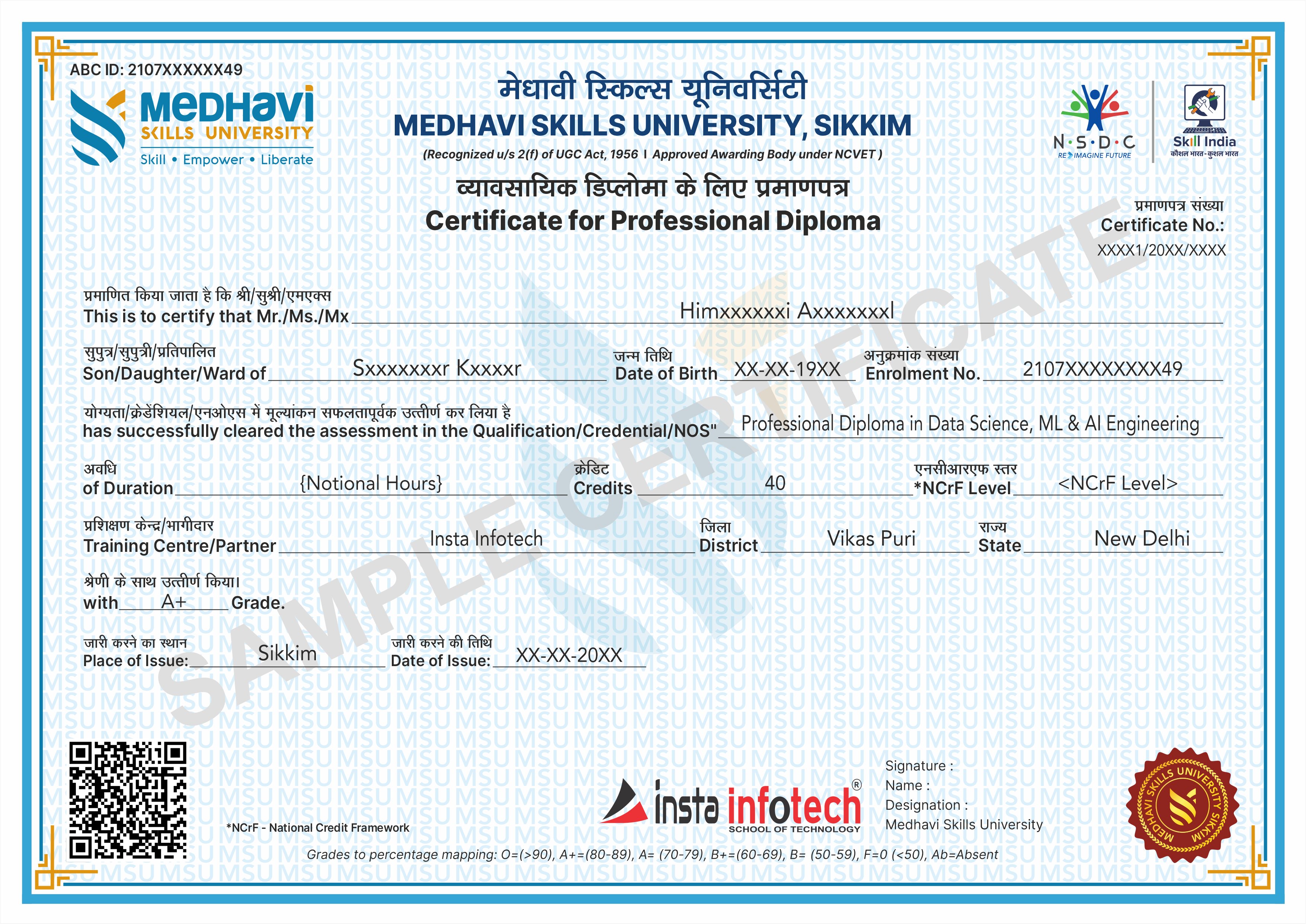
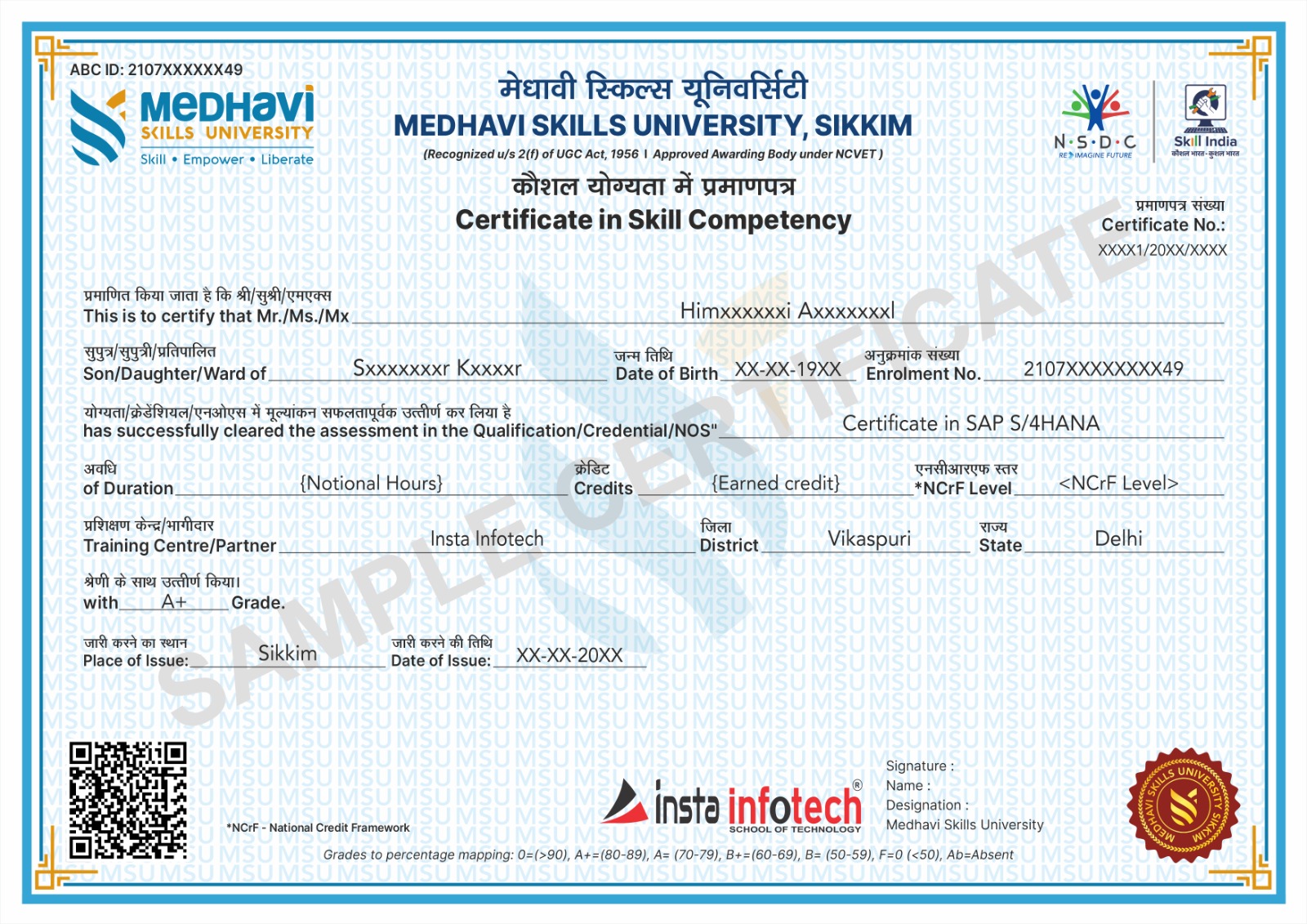
Accreditation Certificate

Professional Diploma Certificate

Skills Certificate

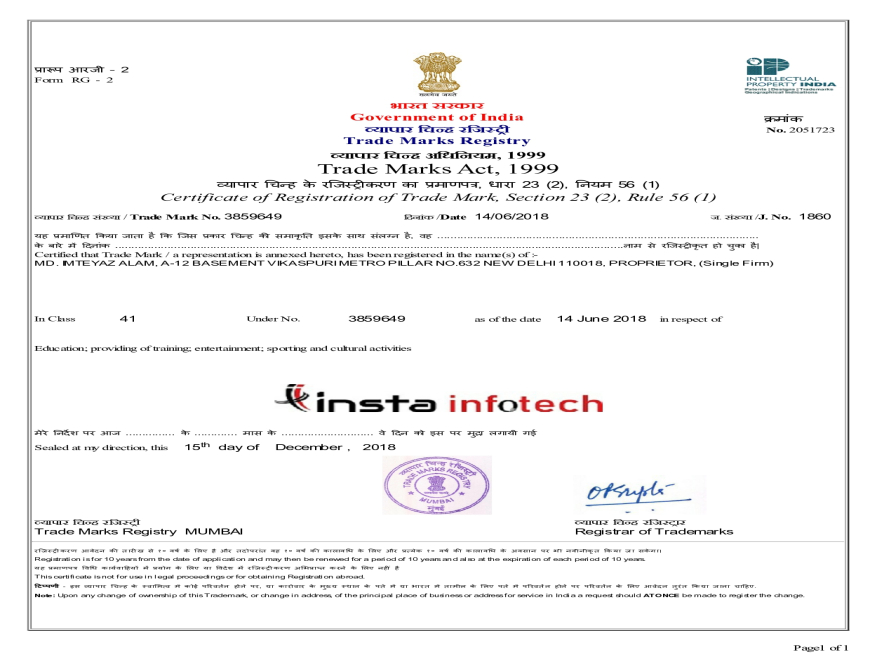
Brand Registration

Trust & Validation

UGC-Recognized Skilled Qualifications for the Modern Global Workforce

University Certification

Earn industry-relevant Certificates and Diplomas awarded by Medhavi Skills University, a UGC-recognized University. Insta Infotech is Approved Training Partner of Medhavi Skills University, ensuring quality education and credible certification.

Certificate Verification

All Certificates and Diplomas are digitally verifiable through Government of India platforms, including Skill India Digital Hub (MSDE), ABC.gov.in (Ministry of Education), and DigiLocker, ensuring authenticity and nationwide recognition.

Credit-Based Course (NCrF)

Our courses are aligned with the National Credit Framework (NCrF) under the National Education Policy (NEP) 2020. Learners earn academic credits that strengthen their skill-based education profile and can be seamlessly transferred toward higher education pathways.

Global Recognition
Global Recognition

NCrF-aligned skill credits are recognized across the UK, EU, and Australian education systems. Through MSU’s global partnerships, learners benefit from dual certification opportunities and accelerated pathways to international degree programs.

Skill India Mission
Skill India Mission

Insta Infotech empowers learners with future-ready skills. Backed by the Skill India Mission and our academic partnership with Medhavi Skills University, we bridge the gap between education and employment through practical, hands-on learning and nationally recognized certifications.

Placement Support
Placement Support

Quality Skill Education — this is not merely a certificate of attendance, but a verified academic credential that enhances credibility and opens opportunities across MNCs, embassies, and government sectors.

Specializations

Skilled, Qualification, Certification

Course Credibility

Course Credibility

Our programs are certified by a recognized university, ensuring legal authenticity, academic validity, and strong professional acceptance. This means your qualification carries real value for employment, career advancement, and higher education.

Employability

Employability

Our programs combine practical training, real-world projects, and industry-relevant skills to prepare students for immediate employment. we ensure learners confidently transition from education to professional careers.

Global Standards

Global Standards

Our programs follow internationally aligned curricula and current industry requirements, ensuring learners gain globally relevant knowledge, practical competencies, and professional practices. This prepares students to adapt, compete, and work confidently.
National Alignment (Skill India)

National Alignment (Skill India)

Aligned with the Skill India Mission, we transform vocational training into a nationally recognized qualification, enabling our students to become part of India’s formal skilled workforce.

Academic Mobility (Credit-Based)

Academic Mobility (Credit-Based)

Through the National Credit Framework (NCrF), our courses are not merely extra-curricular; they are credit-earning modules that contribute directly toward your formal higher education pathway.

NEP 2020 Integration

NEP 2020 Integration

Aligned with the National Education Policy 2020, we transform traditional IT education into a multidisciplinary, skilled-based vocational pathway that enables students to earn formal academic credits.

Our Blogs

Latest Blog Updates

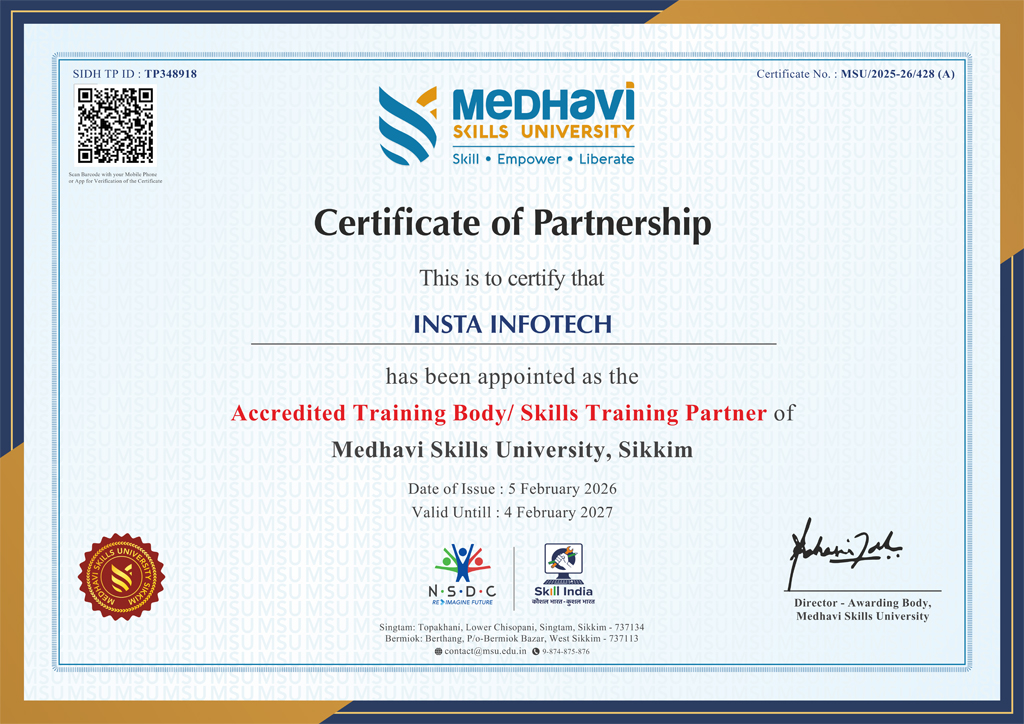
SEO Training Having Great Future Insta Infotech

Internet marketing is now flourishing throughout the world. The widespread use of internet has increased the market of products and services online. This has again increased the demand of online marketers.
Read More

Skillful Website with Developing Standards

If you are planning to choose a career in IT, here you find the career scope in joining Web designing course in Delhi.

Read More

Connect IT Training Peaks

Insta infotech “Software And IT Training Institute” makes an instrument to meet the twin challenges of continuous improvement in IT demand for change

Read More

Pick up High-Level Programming Language Python

Python is a High-level programming language. Python programming can be used for Data Science, Network Programming Web Development, etc. Our training covers python as object Oriented, Python as Data structure, GUI, Database connection with Python. Python is famous language as machine learning, course focus on  learning from beginning to advanced level.

Read More

Specialize in RHCSA certified Professional

Insta Infotech certified candidates with RHCSA practice course with 200+ RHEL7 real-world problem scenarios covering all the exam. An RHCSA® certification is earned when an IT professional try the core system administration skills required in Red Hat Enterprise Linux environments. To become an RHCSA certified, you need to pass the EX200 exam. Only this course has the up to date simulated tests questions, where all questions are carefully scrutinized by real Linux certified professionals.

Read More

Start Your Career As SEO Expert

Search Engine Optimization is one of the essential method you can make use of, attaining more higher rankings but also for running effective Search Engine Optimization campaigns.Today building a career in website development standards is the prime focus on all SEO methods, and also if it's not appropriately implemented. Professional and practical SEO courses in Delhi works on Live Projects that can provide you long-term gains in a shorter period.

Read More

Transform Your Career with Insta InfoTech - Premier IT Training Institute

Join Insta InfoTech for cutting-edge IT training programs designed to boost your skills and career prospects. Offering expert-led Courses in Software Development, Data Science, Cybersecurity, and more.

00+

Trained Students

00+

Years of Experience

00+

Countries Represented

00x7

Support

Insta Infotech

What We Offer

At Insta Infotech, we specialize in a wide array of courses across domains like:

Programming Languages: Java, Python, C++, .NET, and more. Data Science & Analytics: Machine Learning, AI, Big Data. Cloud Computing & DevOps: AWS, Azure, Docker, Kubernetes. Cybersecurity: Ethical Hacking, Network Security. Digital Marketing: SEO, Social Media, Content Marketing. Database Management: SQL, PL/SQL, MongoDB, Oracle.

Enquire Now
Our learners work at