All Courses

Oracle DBA Training Institute

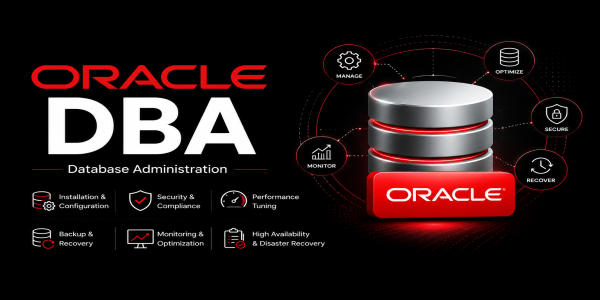
Oracle Database Administrator (DBA) is a multi-model Relational Database management system Developed by Oracle Corporation. Orade DBA is responsible for the organisation, integrity, management of a company's data with great knowledge of Database Management Systems (DBMS) to define, create, maintain, backup, and secure an organisation databases.

Oracle DBA
Oracle DBA

Oracle DBA

Master Oracle Database Administration — the gold standard of enterprise database management trusted by the world's largest banks, governments, and corporations — from Oracle architecture internals and instance management through SQL and PL/SQL programming, Oracle Net, tablespace and storage management, user security, RMAN backup and recovery, Data Guard for high availability, Real Application Clusters (RAC), Oracle Enterprise Manager (OEM), AWR-based performance tuning, and the OCA and OCP certification pathways that make Oracle DBAs among the highest-paid technology professionals in the world.

Certificate
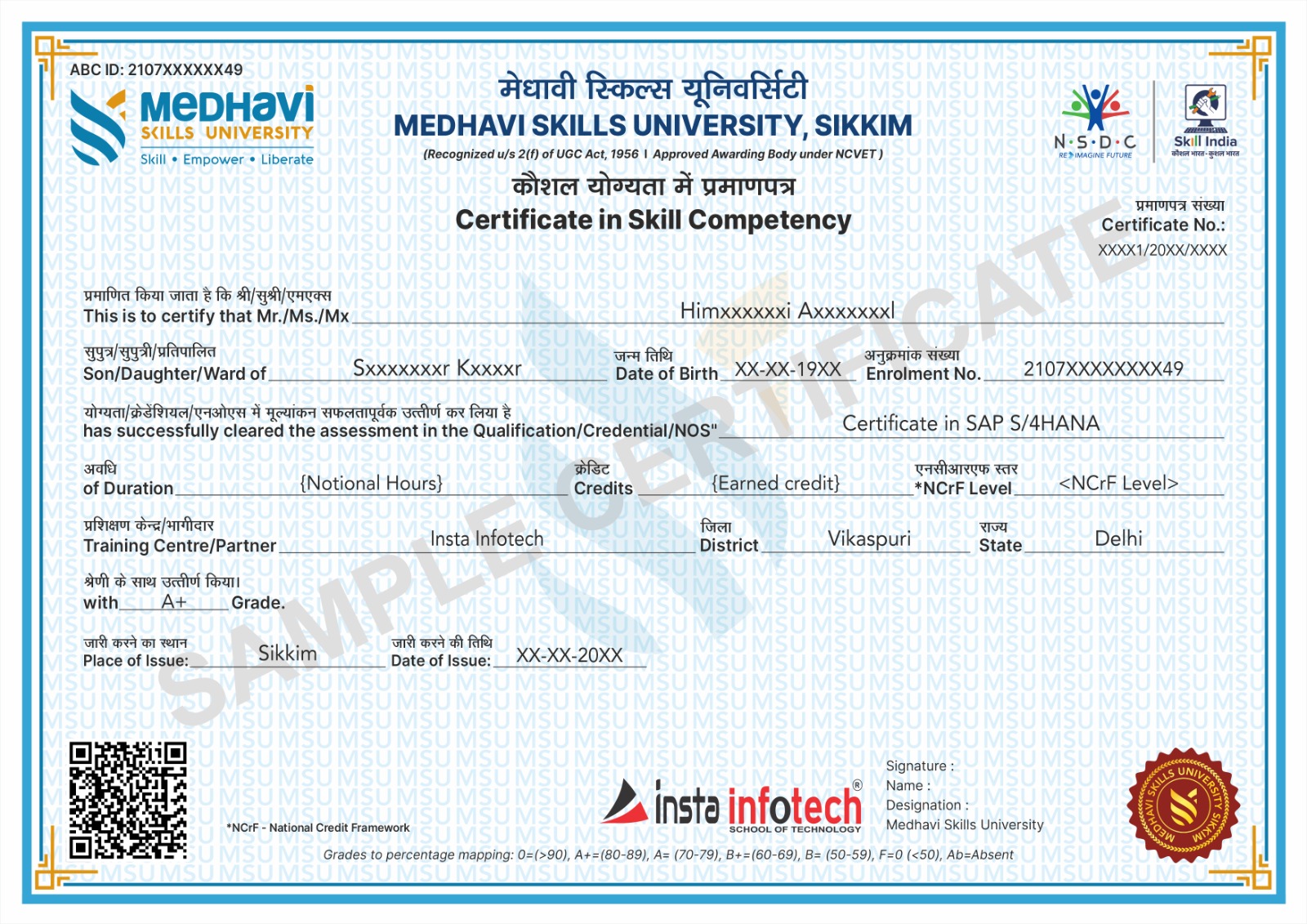
You will get Medhavi Skills Certificate
Partnership
Insta Infotech × Medhavi Skills University
Recognition
NCrF aligned learning pathway
Oracle DBA professional skill tiers
Oracle Architecture, SQL & PL/SQL
Instance, SGA/PGA, storage, and PL/SQL programming
Administer
 
RMAN, Data Guard & RAC
Backup & recovery, high availability, and clustering
Protect
 
OEM, AWR Tuning & OCA/OCP Path
Performance diagnostics, monitoring, and certification prep
Optimise

Administer, protect, and optimise — the three tiers that define a certified Oracle DBA trusted with mission-critical enterprise databases.

 
Program overview

More than knowing Oracle is expensive.

Oracle Database is the world's most powerful and widely deployed enterprise RDBMS, used by 98% of the Fortune 100 for their most critical financial, operational, and transactional data. [web:519] This course teaches Oracle DBA not as a set of GUI clicks but as a discipline — understanding Oracle's multi-tier architecture (CDB/PDB, SGA, background processes), writing production PL/SQL, designing RMAN backup strategies with recovery windows, configuring Data Guard standby for zero-data-loss failover, managing RAC nodes, and tuning queries using AWR and ASH reports — exactly as Oracle DBAs work in banks, telecom companies, and government data centres.

01 / Production-grade scenarios from day one
A live Oracle 19c/21c environment, start to finish.

Students install Oracle Database on Linux, create and manage a CDB with PDBs, configure Oracle Net listeners, allocate tablespaces and datafiles, manage users and roles, and run RMAN backup jobs — all inside the same Oracle 19c or 21c environment used in production at enterprise organisations, not a dumbed-down demo version. [web:525]

02 / Think in Oracle architecture, not just commands
The SGA is not just a memory area.

Most Oracle beginners memorise commands without understanding why the Shared Pool, Buffer Cache, Redo Log Buffer, and PGA interact the way they do — and then can't diagnose a production issue. This course teaches Oracle's memory and process architecture so deeply that students understand exactly why an AWR report looks the way it does and how to act on it. [web:527]

03 / Career signal
The highest-paid database role in IT.

Graduate aligned with the Oracle OCA and OCP certification paths — interview-ready for Oracle DBA, senior database administrator, database architect, PL/SQL developer, and Oracle cloud DBA roles at banks, telecom firms, Oracle partner companies, IT services firms, and government technology departments. [web:517]

 
Learning journey

A clearer learning flow.

The progression begins with Oracle architecture internals and database creation on Linux, advances through SQL and PL/SQL programming, Oracle Net, and storage and security administration, then moves into RMAN backup and recovery, Data Guard standby configuration, and RAC fundamentals, and finishes with Oracle Enterprise Manager, AWR/ASH performance tuning, and OCA/OCP exam preparation with a capstone enterprise DBA project. [web:525]

Step 01
Oracle Architecture & Database Creation
Oracle Database 19c/21c installation on Linux; Oracle architecture — CDB/PDB multitenant model, SGA components (Shared Pool, Buffer Cache, Redo Log Buffer), PGA, and background processes (SMON, PMON, LGWR, DBWR, CKPT); Oracle Universal Installer (OUI); DBCA database creation; SQL*Plus and Oracle SQL Developer orientation. [web:525]
Step 02
SQL, PL/SQL & Oracle Storage Management
Oracle SQL — DDL, DML, joins, subqueries, analytic functions, and Oracle-specific syntax; PL/SQL — blocks, procedures, functions, packages, cursors, exceptions, and triggers; tablespace management — system, undo, temp, and user tablespaces; datafile management and ASM storage basics; Oracle Net configuration — listener.ora and tnsnames.ora. [web:518]
Step 03
User Security, Auditing & Database Maintenance
User management — CREATE USER, GRANT, REVOKE, profiles, and password policies; role-based access control and privilege management; unified auditing — configuring audit policies and log review; undo management and flashback technologies — Flashback Query, Table, and Database; redo log management; and Oracle alert log monitoring. [web:527]
Step 04
RMAN Backup, Data Guard & RAC Fundamentals
RMAN architecture and configuration — backup sets, image copies, retention policies, incremental backups, and recovery catalogue; complete and point-in-time database recovery; Oracle Data Guard — physical standby setup, log transport, switchover and failover; Real Application Clusters (RAC) — architecture, interconnect, and administration basics; and Oracle GoldenGate concepts. [web:525]
Step 05
OEM, AWR Performance Tuning & OCA/OCP Capstone
Oracle Enterprise Manager (OEM) Cloud Control — installation, monitoring, and alerts; AWR, ASH, and ADDM report generation and interpretation; SQL execution plan analysis — EXPLAIN PLAN and SQL Tuning Advisor; memory and I/O performance tuning; database patching with OPatch; OCA (1Z0-082) and OCP exam syllabus coverage; and a full enterprise Oracle DBA capstone project. [web:517]

 
Syllabus

Structured for job-relevant output.

Topics organized into clean thematic groups so the section feels premium and is easy to scan.

Architecture and PL/SQL
  • CDB/PDB, SGA/PGA, and background processes
  • Oracle SQL — analytic functions, Oracle-specific syntax
  • PL/SQL — packages, cursors, exceptions, triggers
HA and recovery
  • RMAN — incremental backups, retention, catalogue
  • Data Guard — physical standby, switchover, failover
  • RAC fundamentals and GoldenGate concepts
Tuning and launch
  • OEM — monitoring, alerts, and patching with OPatch
  • AWR, ASH, ADDM, and SQL Tuning Advisor
  • OCA/OCP exam prep and enterprise capstone project
 
Certification and recognition

Make the credential visible, not buried.

You will receive a Medhavi Skills Certificate. The program is presented through Insta Infotech's partnership with Medhavi Skills University, and the learning pathway is aligned with the National Credit Framework (NCrF). The course content maps to the Oracle OCA (1Z0-082) and OCP certification paths — the globally recognised credentials that define professional Oracle DBAs. [web:517]
Why this matters
 
Certificate + OCA/OCP path
Medhavi Skills Certificate issued on completion, with full syllabus coverage mapped to Oracle's globally recognised OCA and OCP certification exams. [web:517]

 
University partnership
Medhavi Skills University treated as a trust signal, not a small footer note.
 
Fortune 100 deployment signal
Oracle Database is used by 98% of Fortune 100 companies and powers the world's most critical financial, government, and healthcare systems — making certified Oracle DBAs among the highest-paid and most in-demand database professionals globally. [web:519]
Introduction to DBMS
  • Approach to Data Management
  • Introduction to prerequisites, File Settings and File-system
  • Review of Database Management Terminology
  • Database Models
  • Hierarchal Model
  • Network Model
  • Relational Model
Introduction to RDBMS
  • Features & Advantages of RDBMS and DBMS
  • The 12 rules (E.F Codd's Rules -RDBMS)
  • Need for Database Design
  • Support of Normalization Process for Data Management
  • Client-Server Technology
  • Oracle Versions
  • About SQL&SQL*PLUS
Introduction To ORACLE
  • Difference between Oracle Old and latest versions
  • Installation of Oracle Software
  • About SQL*Plus and use of developer tool
  • Data types in Oracle
  • Operators in Oracle
  • Understanding Schema design and objects
ORACLE Sub Language Commands
  • Data Definition Language (DDL)
  • Data Retrieval Language (DRL)
  • Data Manipulation Language (DML)
  • Transaction Control Language (TCL)
  • Database Security and Privileges (DCL)
Working With DDL Commands in ORACLE
  • Table creation using CREATE statement
  • Creating table from another table
  • Dropping a table using DROP command
  • Altering the column of a table
  • Renaming an entire table
  • Using truncate command
  • Difference between Delete and Truncate command
Working With DML Commands in ORACLE
  • Table creation using CREATE statement
  • Creating table from another table
  • Dropping a table using DROP command
  • Altering the column of a table
  • Renaming an entire table
  • Using truncate command
  • Difference between Delete and Truncate command
Working with DCL, TCL Commands in ORACLE
  • Grant, Revoke
  • Page No
  • Commit, Rollback, Save point
  • SQL Editor Commands
  • SQL Environment settings
Managing Users and Securing Database
  • Establishing Security Policy on a Database
  • Privileges and Roles
  • Managing oracle database users
  • How to create a new database user
  • Auditing Database activities
  • Predefined oracle database accounts
Introduction to SQL Database Object in ORACLE
  • Oracle Pre Defined Datatypes
  • DQL-SELECT Statements using WHERE Clause
  • Comparison and Conditional Operators Arithmetic and Logical Operators
  • Special Operators - IN (NOT IN), BETWEEN (NOT BETWEEN), LIKE (NOT LIKE), IS NULL (IS NOT NULL)
  • Working with DML, DRL Commands.
Working with Integrity Constraints in ORACLE
  • Importance of Data Integrity
  • How to add constraints to an existing table?
  • NOT NULL constraint
  • UNIQUE constraint + PRIMARY KEY constraint
  • FOREIGN KEY constraint
  • CHECK constraint
  • Applying DEFAULT option to columns
  • How to enable and disable constraints?
  • How to get information about constraints?
Data Retrieval Techniques in ORACLE
  • How to use select statement in different ways to retrieve records?
  • Working with Column and table alias
  • Data filtering and sorting with in single table
  • Clauses and its types in oracle
  • Where clause & Having clause & From clause
  • Group by clause, Order by clause
  • Constraint clause
Built-in Functions in ORACLE
  • How to use single row functions using dummy table?
  • Character Functions and String functions
  • Date functions
  • Mathematical functions
  • Conversion functions
  • Aggregate Functions
  • Special functions
  • Analytical functions
Set Operators in ORACLE
  • Working with set operator types
  • UNION and UNION ALL
  • INTERSECT
  • MINUS
Pseudo Columns in Oracle
  • Understanding Pseudo Columns in Oracle
  • Types of Pseudo Columns in Oracle
  • CURRVAL and NEXTVAL
  • LEVEL
  • ROWID
  • ROWNUM
Functions in PL/SQL in ORACLE
  • Difference between Procedures and Functions
  • How to create functions?
  • How to use inline functions?
  • Nested Functions
  • Using stored function in SQL statements
Querying Multiple Tables (Joins) in ORACLE
  • Understanding joins and its uses
  • Types of joins
  • Simple Join / Equi-join / Inner Join / Outer join
  • Left & Right outer join and Full outer join
  • Cross join
Sub Queries in ORACLE
  • Importance of sub queries
  • Using different types of sub queries
  • Single row sub queries and Multi row sub queries
  • Nested queries
  • Multi column sub queries
  • IN, ANY/SOME, ALL Operators in Sub Queries
  • Handling Data Retrieval with EXISTS and NOT EXISTS Operators
VIEWS in Oracle
  • Types of VIEWS
  • Relational Views and Object Views
  • Practical approach of SIMPLE VIEWS and COMPLEX VIEWS
  • Column definitions in VIEWS
  • Using VIEWS for DML Operations
  • Putting CHECK Constraint upon VIEWS
  • Creation of READ ONLY VIEWS
  • Understanding the IN LINE VIEWS
  • About Materialized Views
  • View Triggers
Triggers in PL/SQL in ORACLE
  • How to create triggers?
  • Benefits of trigger
  • Using DML trigger & DDL trigger
  • How to audit database using triggers?
  • What are database level trigger?
Creation Of Stored Procedures in ORACLE
  • Creating Procedures in PL/SQL
  • IN parameter / OUT parameter / INOUT parameter
  • Procedure with Cursors
  • Dropping a Procedure
Creating and Using Cursors in ORACLE
  • How to create cursors in PL/SQL
  • How to create explicit cursor?
  • What are cursor parameters?
  • How to use for update clause?
  • How to use implicit cursors?
Introduction to PL/SQL (Procedural Language Extension to SQL)
  • Introduction & advantages of PL/SQL
  • Datatypes, Variable and Constants in PL/SQL
  • Conditional and Unconditional Statements
  • Simple if, if... else, nested if..else, if..else Ladder
  • Selection Case, Simple Case, GOTO Label and EXIT
  • Simple LOOP, WHILE LOOP, FOR LOOP and NESTED LOOPS
  • SQL within PL/SQL
Implementing OOPS Technology in ORACLE
  • What is Object Technology?
  • Creation of classes and objects
  • Inserting rows in a table using Objects
  • Retrieving data from Object-based Tables
  • Calling a Method
Design Of Schema Objects in ORACLE
  • Creating and working with Views
  • Working with Synonyms
  • Creating Index and clusters
  • Working with in materialized view
  • Understanding sequences and its types
File Input/Output in ORACLE
  • PL/SQL file I/O (Input/Output)
  • SQL* Loader Architecture
  • .txt to base table
Procedure in Oracle
  • Create procedure
  • Declare Values & Variables in Procedure.
  • Call & Invoke procedure
Creating & Using Packages in ORACLE
  • What is a Package?
  • Reasons to use packages
  • What is package specification?
  • What is package body?
  • How to initialize instantiated package?
  • Creating PACKAGE Specification and PACKAGE Body
Collections In PL/SQL in ORACLE
  • What is collection?
  • How to use arrays?
  • Using nested tables
  • How to use index by value?
  • Listing types of collection methods.
Exception Handling in ORACLE
  • What is an Exception and Types of exceptions?
  • Handling system defined exceptions
  • Handling user defined exceptions?
  • RAISE_APPLICATION_ERROR
  • SQL Error Code Values
Advanced Features in ORACLE LATEST VERSIONS
  • Introduction to Oracle Database Architecture & its Type
  • Merge statement
  • Temporary Tables/Global Tables
  • New Function EXTRACT()
  • About Flash Back Queries
  • New data types, Flash back Command
  • Regular expressions, DML Error Logging
  • Types of Table spaces
Security and Locks in ORACLE LATESET VERSIONS.
  • Row level Locks
  • Table Level Locks
  • Use of commit and rollback
  • Use of save-point and set transaction
  • How to give system privileges to an user?
  • How to invoke and revoke object privileges?
  • How to create users and roles?

Send Me Message

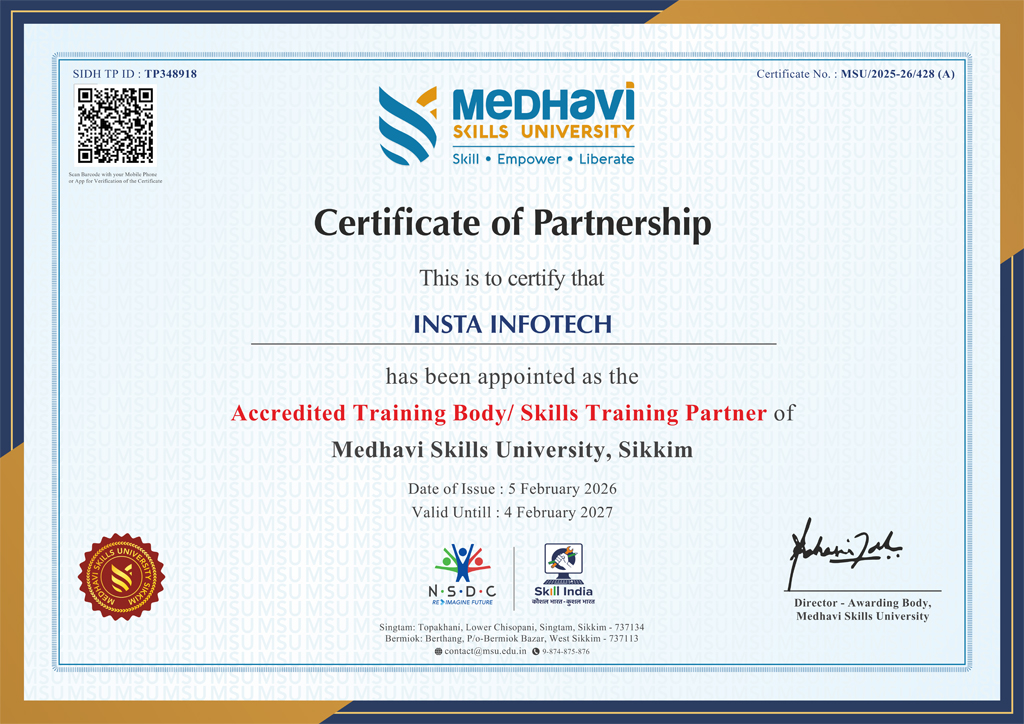
Certificate and Accreditation

Accreditation Certificate

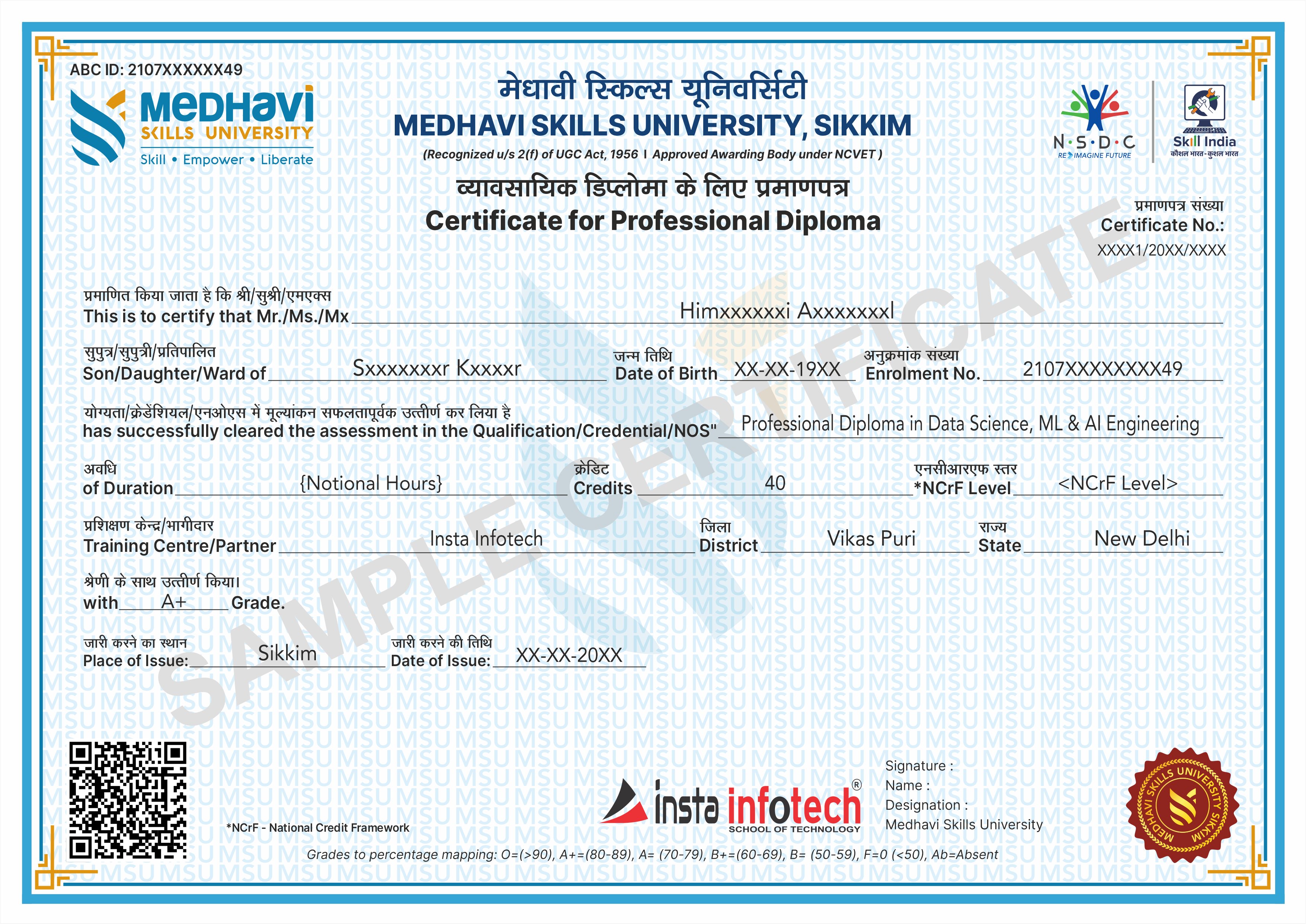
Professional Diploma Certificate

Skills Certificate

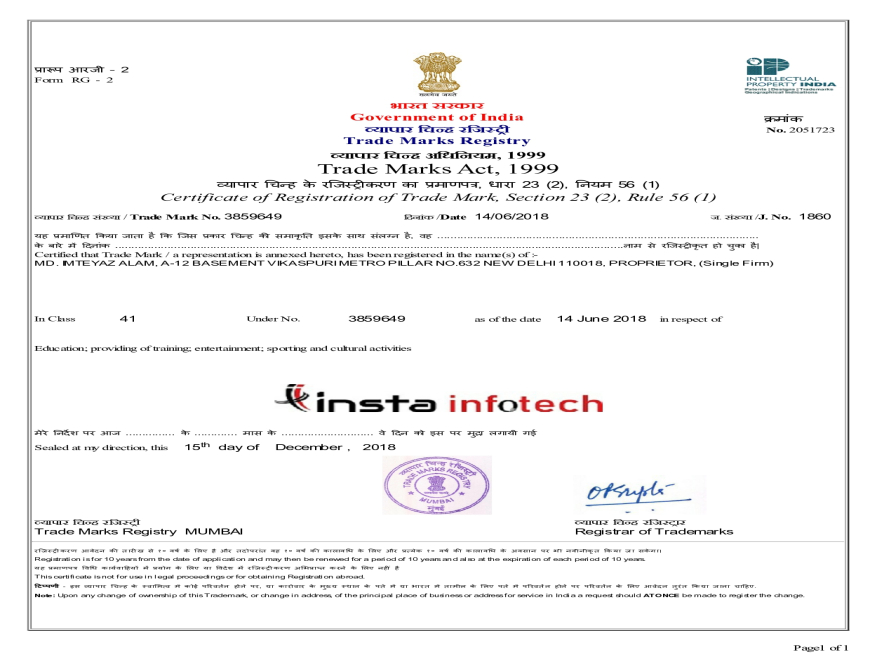
Brand Registration

Trust & Validation

UGC-Recognized Skilled Qualifications for the Modern Global Workforce

University Certification

Earn industry-relevant Certificates and Diplomas awarded by Medhavi Skills University, a UGC-recognized University. Insta Infotech is Approved Training Partner of Medhavi Skills University, ensuring quality education and credible certification.

Certificate Verification

All Certificates and Diplomas are digitally verifiable through Government of India platforms, including Skill India Digital Hub (MSDE), ABC.gov.in (Ministry of Education), and DigiLocker, ensuring authenticity and nationwide recognition.

Credit-Based Course (NCrF)

Our courses are aligned with the National Credit Framework (NCrF) under the National Education Policy (NEP) 2020. Learners earn academic credits that strengthen their skill-based education profile and can be seamlessly transferred toward higher education pathways.

Global Recognition
Global Recognition

NCrF-aligned skill credits are recognized across the UK, EU, and Australian education systems. Through MSU’s global partnerships, learners benefit from dual certification opportunities and accelerated pathways to international degree programs.

Skill India Mission
Skill India Mission

Insta Infotech empowers learners with future-ready skills. Backed by the Skill India Mission and our academic partnership with Medhavi Skills University, we bridge the gap between education and employment through practical, hands-on learning and nationally recognized certifications.

Placement Support
Placement Support

Quality Skill Education — this is not merely a certificate of attendance, but a verified academic credential that enhances credibility and opens opportunities across MNCs, embassies, and government sectors.

Specializations

Skilled, Qualification, Certification

Course Credibility

Course Credibility

Our programs are certified by a recognized university, ensuring legal authenticity, academic validity, and strong professional acceptance. This means your qualification carries real value for employment, career advancement, and higher education.

Employability

Employability

Our programs combine practical training, real-world projects, and industry-relevant skills to prepare students for immediate employment. we ensure learners confidently transition from education to professional careers.

Global Standards

Global Standards

Our programs follow internationally aligned curricula and current industry requirements, ensuring learners gain globally relevant knowledge, practical competencies, and professional practices. This prepares students to adapt, compete, and work confidently.

National Alignment (Skill India)

National Alignment (Skill India)

Aligned with the Skill India Mission, we transform vocational training into a nationally recognized qualification, enabling our students to become part of India’s formal skilled workforce.

Academic Mobility (Credit-Based)

Academic Mobility (Credit-Based)

Through the National Credit Framework (NCrF), our courses are not merely extra-curricular; they are credit-earning modules that contribute directly toward your formal higher education pathway.

NEP 2020 Integration

NEP 2020 Integration

Aligned with the National Education Policy 2020, we transform traditional IT education into a multidisciplinary, skilled-based vocational pathway that enables students to earn formal academic credits.

Our Blogs

Latest Blog Updates

SEO Training Having Great Future Insta Infotech

Internet marketing is now flourishing throughout the world. The widespread use of internet has increased the market of products and services online. This has again increased the demand of online marketers.

Read More

Skillful Website with Developing Standards

If you are planning to choose a career in IT, here you find the career scope in joining Web designing course in Delhi.

Read More

Connect IT Training Peaks

Insta infotech “Software And IT Training Institute” makes an instrument to meet the twin challenges of continuous improvement in IT demand for change

Read More

Pick up High-Level Programming Language Python

Python is a High-level programming language. Python programming can be used for Data Science, Network Programming Web Development, etc. Our training covers python as object Oriented, Python as Data structure, GUI, Database connection with Python. Python is famous language as machine learning, course focus on  learning from beginning to advanced level.

Read More

Specialize in RHCSA certified Professional

Insta Infotech certified candidates with RHCSA practice course with 200+ RHEL7 real-world problem scenarios covering all the exam. An RHCSA® certification is earned when an IT professional try the core system administration skills required in Red Hat Enterprise Linux environments. To become an RHCSA certified, you need to pass the EX200 exam. Only this course has the up to date simulated tests questions, where all questions are carefully scrutinized by real Linux certified professionals.

Read More

Start Your Career As SEO Expert

Search Engine Optimization is one of the essential method you can make use of, attaining more higher rankings but also for running effective Search Engine Optimization campaigns.Today building a career in website development standards is the prime focus on all SEO methods, and also if it's not appropriately implemented. Professional and practical SEO courses in Delhi works on Live Projects that can provide you long-term gains in a shorter period.

Read More

Transform Your Career with Insta InfoTech - Premier IT Training Institute

Join Insta InfoTech for cutting-edge IT training programs designed to boost your skills and career prospects. Offering expert-led Courses in Software Development, Data Science, Cybersecurity, and more.

00+

Trained Students

00+

Years of Experience

00+

Countries Represented

00x7

Support

Insta Infotech

What We Offer

At Insta Infotech, we specialize in a wide array of courses across domains like:

Programming Languages: Java, Python, C++, .NET, and more. Data Science & Analytics: Machine Learning, AI, Big Data. Cloud Computing & DevOps: AWS, Azure, Docker, Kubernetes. Cybersecurity: Ethical Hacking, Network Security. Digital Marketing: SEO, Social Media, Content Marketing. Database Management: SQL, PL/SQL, MongoDB, Oracle.
Enquire Now
Our learners work at