All Courses

Professional Diploma in Cyber Security & Ethical Hacking "Medhavi Skills University"

Insta Infotech’s Professional Diploma in Cyber Security & Ethical Hacking is designed for learners who want structured, university-level education in cyber security with real-world application.

This program carries 40 academic credits aligned with India’s National Credit Framework (NCrF) and is awarded in academic partnership with Medhavi Skills University, a UGC-recognized university.

Through hands-on labs, applied security scenarios, and guided training, learners develop job-relevant skills for roles in cyber security operations, ethical hacking, and information security.


Professional Diploma in Cyber Security & Ethical Hacking
INSTA INFOTECH | PROFESSIONAL DIPLOMA

Diploma in Cyber Security & Ethical Hacking

Learn to protect networks and systems, assess vulnerabilities, practise authorised ethical hacking and document security findings through guided exercises and practical labs.

18 curriculum modules Hands-on security labs Networking + Ethical Hacking Academic credit programme*

*Confirm the awarding details, applicable 40 academic credits and individual admission conditions with Insta Infotech before enrolment.

PROGRAMME OVERVIEW

Build Practical Cyber Security Skills

Cyber security focuses on protecting networks, systems and information. Ethical hacking applies authorised testing methods to identify weaknesses and recommend improvements before threats cause harm.

Explore networking and Linux, security fundamentals, vulnerability assessment, ethical hacking and web security, incident response, and hands-on reporting. Practical testing should be performed only in permitted lab environments.

NET

Network Defence

Understand network services, systems and security controls.

TEST

Security Testing

Identify, assess and document vulnerabilities in authorised environments.

SOC

Incident Response

Review alerts, investigate evidence and report findings.

LAB

Practical Labs

Apply security concepts through guided exercises and reports.

CURRICULUM

Explore 18 Core Cyber Security Modules

Follow a focused learning path from networking and security foundations to authorised testing, monitoring, investigation and reporting.

CS

Module 01: Cyber Security Basics

Topics: Security Concepts, Security Principles.

RT

Module 02: Risk & Threat Management

Topics: Threat Types, Risk Assessment.

NB

Module 03: Network Basics

Topics: OSI Model, TCP/IP Model.

IA

Module 04: IP Addressing

Topics: IPv4 & IPv6, Network Devices.

OF

Module 05: OS Fundamentals

Topics: Windows OS, Linux OS.

SS

Module 06: System Security

Topics: Access Control, System Hardening.

HF

Module 07: Hacking Fundamentals

Topics: Types of Hackers, Footprinting.

SE

Module 08: Scanning & Enumeration

Topics: Network Scanning, Enumeration.

NT

Module 09: Network Threats

Topics: Malware, Attacks.

SC

Module 10: Security Controls

Topics: Firewalls, IDS/IPS.

PT

Module 11: Pen Testing

Topics: Methodologies, Tools.

VA

Module 12: Vulnerability Assessment

Topics: Scanning, Reporting.

WS

Module 13: Web Security

Topics: Web Attacks, Session Management.

SD

Module 14: Secure Development

Topics: Secure Coding, Testing.

C

Module 15: Cryptography

Topics: Encryption, Hashing.

CS

Module 16: Cloud Security

Topics: Cloud Models, Cloud Threats.

CL

Module 17: Cyber Laws

Topics: IT Laws, Ethics.

DF

Module 18: Digital Forensics

Topics: Evidence Collection, Investigation & Project.

PRACTICAL EXPERIENCE

Learn Through Security Labs

Apply course concepts in responsible, authorised practical exercises. The examples below illustrate relevant lab activities; confirm the exact assessed projects with admissions.

PROJECT 01

Network Traffic Review

Inspect sample packet captures and identify normal and unusual network behaviour.

PROJECT 02

Vulnerability Review

Analyse an authorised test environment, categorise findings and propose mitigations.

PROJECT 03

Incident Investigation

Review example alerts and system logs, document observations and propose a response workflow.

PROJECT 04

Security Assessment Report

Produce a concise lab-based assessment with evidence, risk prioritisation and recommended fixes.

PROGRAMME DETAILS

Eligibility & Qualification

Eligibility

Confirm the applicable admission eligibility and prerequisites with the institute.

Programme name

Diploma in Cyber Security & Ethical Hacking.

Course delivery

Request verified classroom / online options, lab arrangements and upcoming batch details.

Academic award

Insta Infotech describes this programme in connection with Medhavi Skills University and 40 academic credits. Confirm the awarding institution, credit applicability and recognition terms before admission.

CAREER PATHWAYS

Explore Cyber Security Career Roles

These are examples of roles related to cyber security skills, not guaranteed placement outcomes. Specific job requirements depend on qualifications, experience and employer needs.

SOC Analyst Trainee

Assist with alert reviews, basic log analysis and incident escalation.

Security Support Analyst

Support access reviews, routine security checks and documentation.

Junior Penetration Tester

Contribute to authorised security tests and document findings under supervision.

Vulnerability Assessment Assistant

Help identify, categorise and report potential weaknesses.

Network Security Support

Help maintain network security controls and secure configurations.

Digital Forensics Trainee

Support structured log and evidence review under defined procedures.

COMMON QUESTIONS

Frequently Asked Questions

What will I learn in this diploma?

The course covers networking and Linux basics, cyber security foundations, vulnerability assessment, ethical hacking concepts, monitoring and practical reporting.

Is ethical hacking taught responsibly?

Ethical hacking exercises should take place only in approved labs or on systems where explicit testing permission exists.

Are practical labs included?

The page describes guided security labs and practice; ask admissions for the current lab access and assessed exercise list.

Do I need prior technical knowledge?

Confirm the current entry requirements and any recommended networking or computing prerequisites with admissions.

Will I learn to assess vulnerabilities?

The curriculum outline covers identifying security weaknesses, analysing findings and proposing remediation.

What qualification and credits are awarded?

The offering references Medhavi Skills University and 40 academic credits. Verify the issuing institution, credit conditions and award documents before enrolling.

Is a job or placement guaranteed?

No employment outcome is guaranteed. Ask admissions about currently available career and placement support.

How can I check fees, batches and study mode?

Contact Insta Infotech for the current fee schedule, admission availability, location and delivery options.

TAKE THE NEXT STEP

Start Your Cyber Security Journey

Ask about the syllabus, practical labs, academic award, admission criteria, fees and upcoming batches.

Request Course Details

Module 1: Fundamentals of Cyber Security
  • Security Concepts
  • Explain cyber security concepts and terminology
  • Describe types of cyber threats and vulnerabilities
  • Analyze importance of information security
  • Identify cyber threats in real-world scenarios
  • Analyze security breaches and case studies
  • Security Principles
  • Explain CIA triad and risk concepts
  • Analyze security controls and policies
  • Evaluate risks in systems
  • Identify vulnerabilities
  • Threat Types
  • Classify cyber threats and attack vectors
  • Analyze threat landscape
  • Identify attack types in systems
  • Assess potential risks
  • Risk Assessment
  • Explain risk assessment process
  • Analyze vulnerabilities and impacts
  • Perform basic risk assessment
  • Prepare risk reports

Module 2: Networking Fundamentals
  • OSI Model
  • Explain OSI layers and functions
  • Analyze protocol operations
  • Map protocols to layers
  • Analyze packet flow
  • TCP/IP Model
  • Explain TCP/IP architecture
  • Analyze network communication
  • Configure network settings
  • Test connectivity
  • IPv4 & IPv6
  • Explain IP addressing schemes
  • Analyze subnetting concepts
  • Perform subnetting
  • Assign IP addresses
  • Network Devices
  • Explain routers, switches, firewalls
  • Analyze network topology
  • Configure basic network devices
  • Troubleshoot network issues

Module 3: Operating Systems & System Security
  • Windows OS
  • Explain Windows architecture
  • Analyze system components
  • Install and configure Windows OS
  • Manage users and permissions
  • Linux OS
  • Explain Linux structure and commands
  • Analyze system processes
  • Execute Linux commands
  • Manage files and users
  • Access Control
  • Explain authentication and authorization
  • Analyze access control models
  • Configure access permissions
  • Implement security settings
  • System Hardening
  • Explain system hardening techniques
  • Analyze vulnerabilities
  • Apply system hardening practices
  • Secure OS configurations

Module 4: Ethical Hacking & Reconnaissance
  • Types of Hackers
  • Explain types of hackers and attacks
  • Analyze hacking methodologies
  • Identify attack techniques
  • Analyze case studies
  • Footprinting
  • Explain footprinting techniques
  • Analyze information gathering methods
  • Perform footprinting using tools
  • Collect target data
  • Network Scanning
  • Explain scanning techniques
  • Analyze open ports and services
  • Perform network scanning
  • Identify vulnerabilities
  • Enumeration
  • Explain enumeration methods
  • Analyze system information extraction
  • Perform enumeration
  • Extract system details

Module 5: Network Security & Defense
  • Malware
  • Explain types of malware and attacks
  • Analyze threat behavior
  • Detect malware activity
  • Analyze infected systems
  • Attacks
  • Explain DoS, MITM, phishing attacks
  • Analyze attack patterns
  • Simulate attacks in lab
  • Identify vulnerabilities
  • Firewalls
  • Explain firewall types and rules
  • Analyze traffic filtering
  • Configure firewall rules
  • Monitor network traffic
  • IDS/IPS
  • Explain IDS/IPS systems
  • Analyze intrusion detection methods
  • Configure IDS/IPS
  • Detect intrusions

Module 6: Penetration Testing & Vulnerability Assessment
  • Methodologies
  • Explain penetration testing phases
  • Analyze testing frameworks
  • Plan penetration testing process
  • Document testing approach
  • Tools
  • Explain pen testing tools
  • Analyze tool capabilities
  • Use tools like Nmap, Metasploit
  • Perform testing
  • Scanning
  • Explain vulnerability scanning methods
  • Analyze scan results
  • Perform vulnerability scans
  • Identify weaknesses
  • Reporting
  • Explain reporting standards
  • Analyze findings
  • Prepare vulnerability reports
  • Recommend fixes

Module 7: Web Application Security
  • Web Attacks
  • Explain OWASP vulnerabilities
  • Analyze attack techniques
  • Test web applications
  • Identify vulnerabilities
  • Session Management
  • Explain session handling
  • Analyze session risks
  • Test session security
  • Fix vulnerabilities
  • Secure Coding
  • Explain secure coding practices
  • Analyze input validation
  • Apply secure coding techniques
  • Fix code issues
  • Testing
  • Explain security testing methods
  • Analyze application risks
  • Perform web security testing
  • Validate fixes

Module 8: Cryptography & Cloud Security
  • Encryption
  • Explain encryption techniques
  • Analyze cryptographic algorithms
  • Implement encryption methods
  • Secure data
  • Hashing
  • Explain hashing functions
  • Analyze data integrity methods
  • Generate hashes
  • Verify integrity
  • Cloud Models
  • Explain cloud models (IaaS, PaaS, SaaS)
  • Analyze cloud architecture
  • Configure cloud services
  • Manage cloud resources
  • Cloud Threats
  • Explain cloud risks
  • Analyze security controls
  • Implement cloud security measures
  • Monitor cloud systems

Module 9: Cyber Laws, Digital Forensics & Project
  • IT Laws
  • Explain cyber laws and compliance
  • Analyze legal requirements
  • Apply legal guidelines
  • Ensure compliance
  • Ethics
  • Explain ethical hacking standards
  • Analyze professional conduct
  • Apply ethical practices
  • Maintain compliance
  • Evidence Collection
  • Explain forensic procedures
  • Analyze evidence handling
  • Collect digital evidence
  • Preserve data integrity
  • Investigation & Project
  • Explain investigation process
  • Analyze case findings
  • Perform forensic analysis
  • Execute project and present report

Send Me Message

Certificate and Accreditation

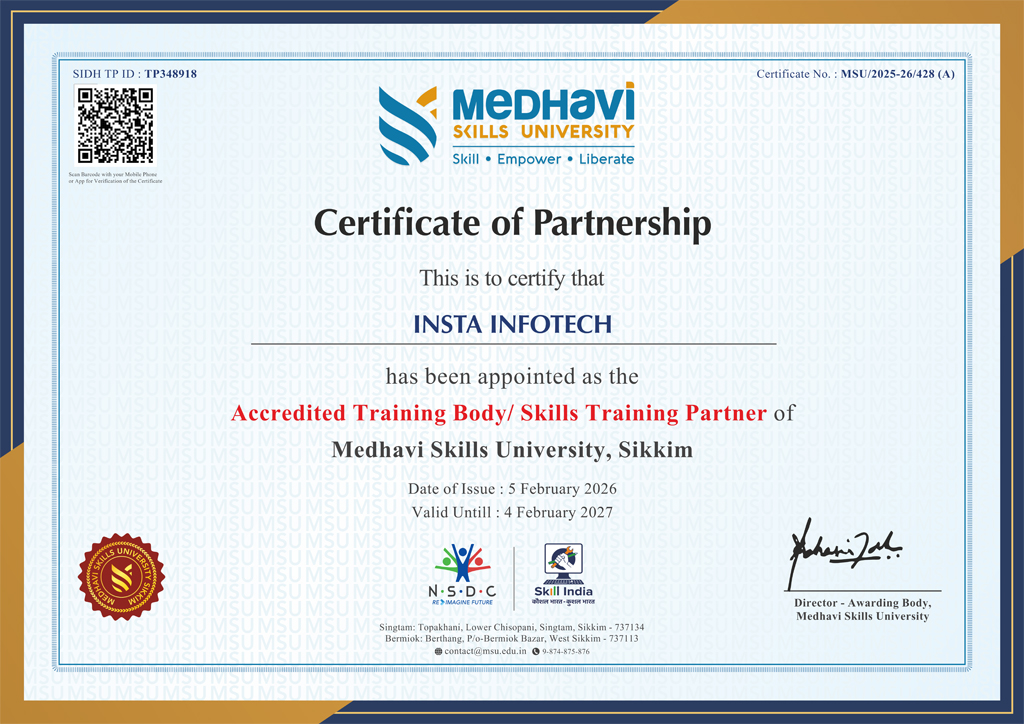
Accreditation Certificate

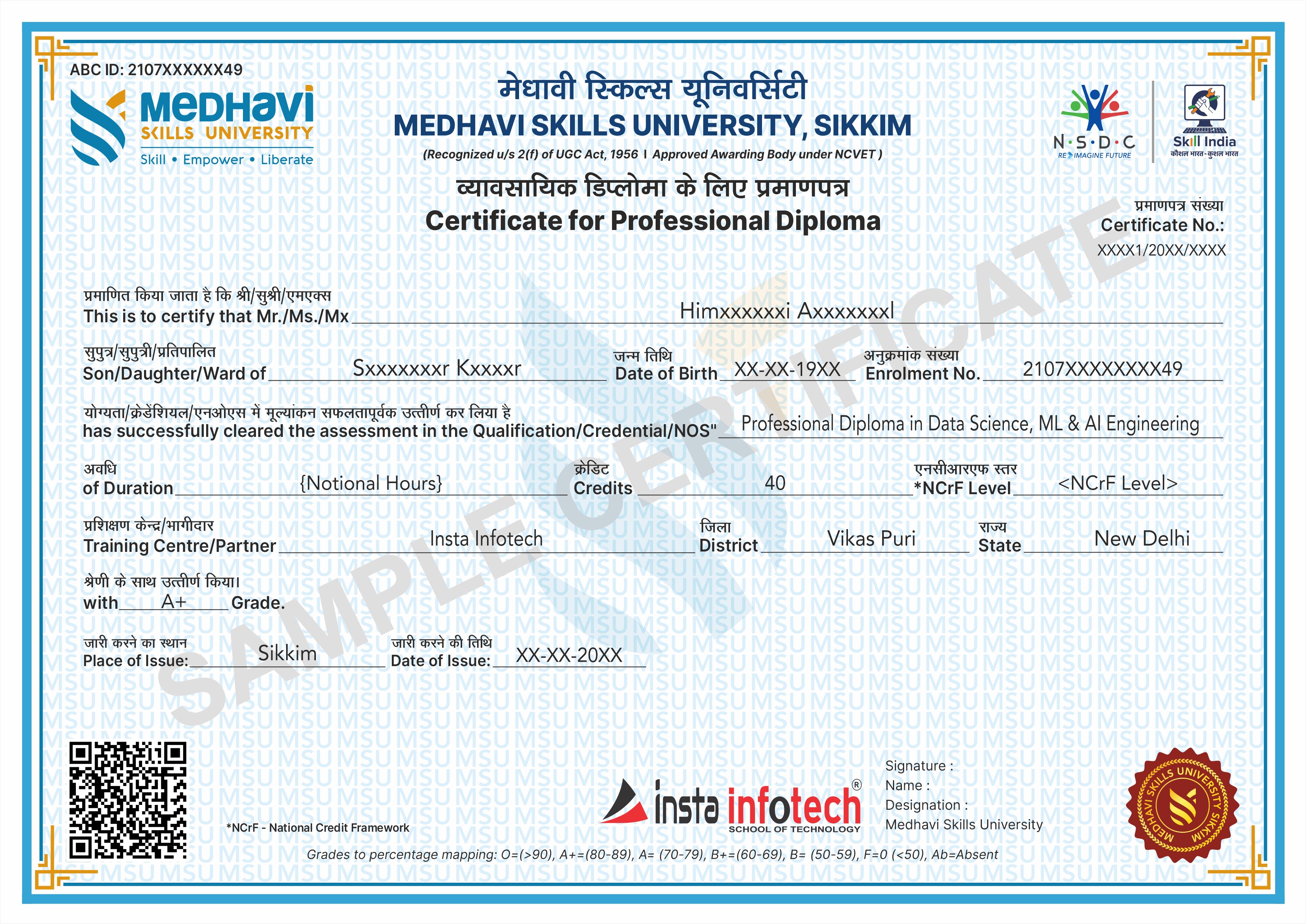
Professional Diploma Certificate

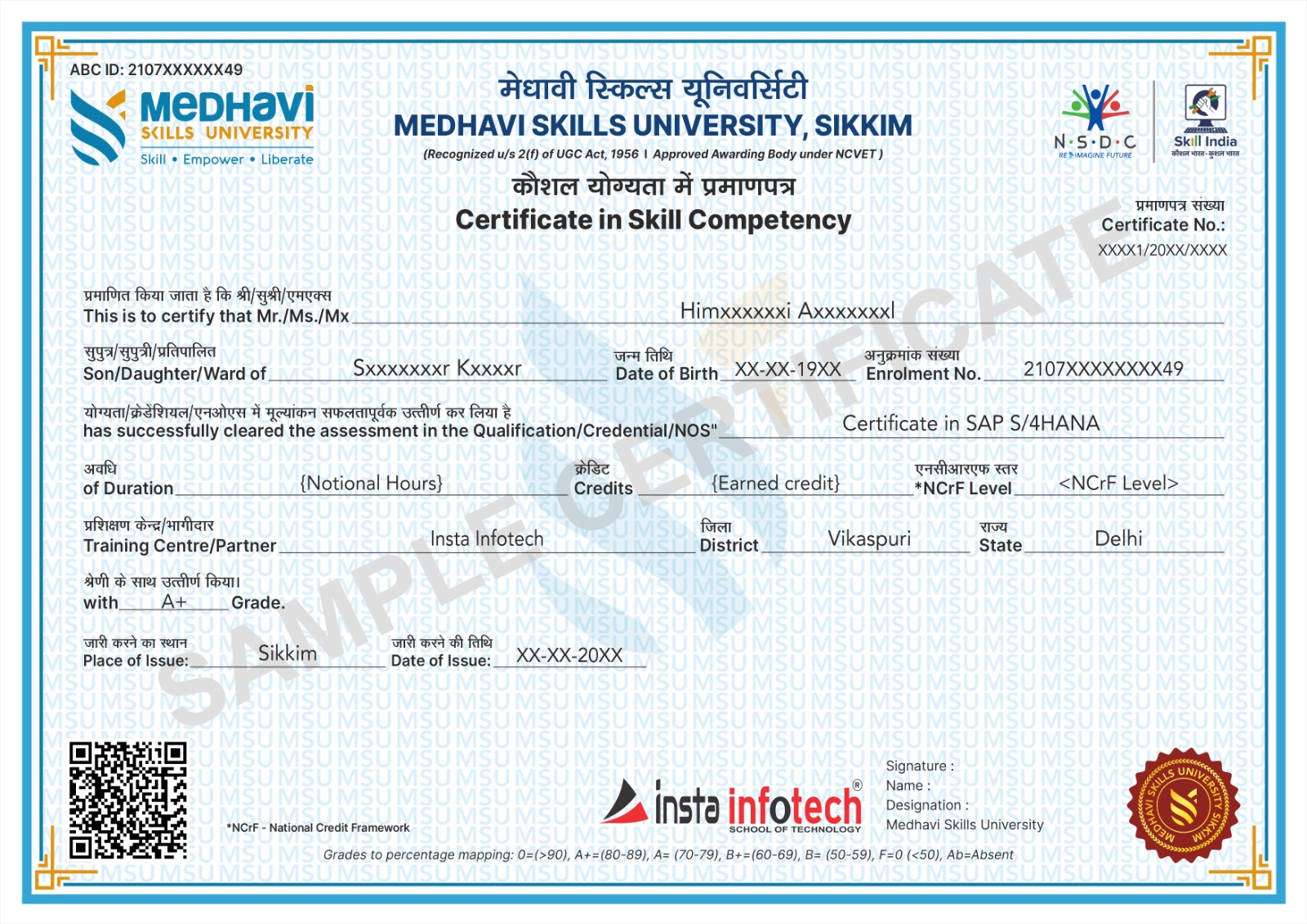
Skills Certificate

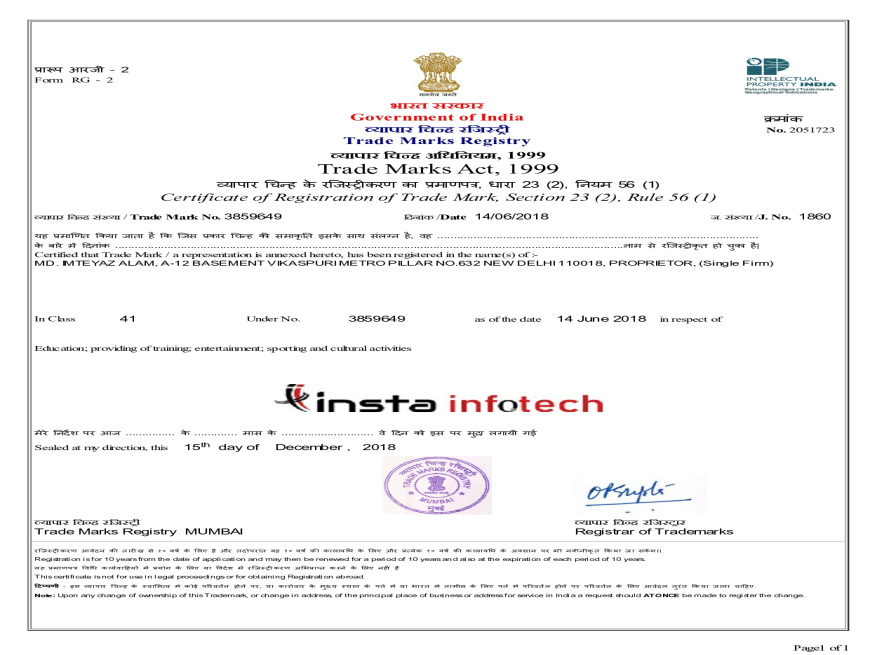
Brand Registration

Trust & Validation

UGC-Recognized Skilled Qualifications for the Modern Global Workforce

University Certification

Earn industry-relevant Certificates and Diplomas awarded by Medhavi Skills University, a UGC-recognized University. Insta Infotech is Approved Training Partner of Medhavi Skills University, ensuring quality education and credible certification.

Certificate Verification

All Certificates and Diplomas are digitally verifiable through Government of India platforms, including Skill India Digital Hub (MSDE), ABC.gov.in (Ministry of Education), and DigiLocker, ensuring authenticity and nationwide recognition.

Credit-Based Course (NCrF)

Our courses are aligned with the National Credit Framework (NCrF) under the National Education Policy (NEP) 2020. Learners earn academic credits that strengthen their skill-based education profile and can be seamlessly transferred toward higher education pathways.

Global Recognition
Global Recognition

NCrF-aligned skill credits are recognized across the UK, EU, and Australian education systems. Through MSU’s global partnerships, learners benefit from dual certification opportunities and accelerated pathways to international degree programs.

Skill India Mission
Skill India Mission

Insta Infotech empowers learners with future-ready skills. Backed by the Skill India Mission and our academic partnership with Medhavi Skills University, we bridge the gap between education and employment through practical, hands-on learning and nationally recognized certifications.

Placement Support
Placement Support

Quality Skill Education — this is not merely a certificate of attendance, but a verified academic credential that enhances credibility and opens opportunities across MNCs, embassies, and government sectors.

Specializations

Skilled, Qualification, Certification

Course Credibility

Course Credibility

Our programs are certified by a recognized university, ensuring legal authenticity, academic validity, and strong professional acceptance. This means your qualification carries real value for employment, career advancement, and higher education.

Employability

Employability

Our programs combine practical training, real-world projects, and industry-relevant skills to prepare students for immediate employment. we ensure learners confidently transition from education to professional careers.

Global Standards

Global Standards

Our programs follow internationally aligned curricula and current industry requirements, ensuring learners gain globally relevant knowledge, practical competencies, and professional practices. This prepares students to adapt, compete, and work confidently.

National Alignment (Skill India)

National Alignment (Skill India)

Aligned with the Skill India Mission, we transform vocational training into a nationally recognized qualification, enabling our students to become part of India’s formal skilled workforce.

Academic Mobility (Credit-Based)

Academic Mobility (Credit-Based)

Through the National Credit Framework (NCrF), our courses are not merely extra-curricular; they are credit-earning modules that contribute directly toward your formal higher education pathway.

NEP 2020 Integration

NEP 2020 Integration

Aligned with the National Education Policy 2020, we transform traditional IT education into a multidisciplinary, skilled-based vocational pathway that enables students to earn formal academic credits.

Our Blogs

Latest Blog Updates

SEO Training Having Great Future Insta Infotech

Internet marketing is now flourishing throughout the world. The widespread use of internet has increased the market of products and services online. This has again increased the demand of online marketers.

Read More

Skillful Website with Developing Standards

If you are planning to choose a career in IT, here you find the career scope in joining Web designing course in Delhi.

Read More

Connect IT Training Peaks

Insta infotech “Software And IT Training Institute” makes an instrument to meet the twin challenges of continuous improvement in IT demand for change

Read More

Pick up High-Level Programming Language Python

Python is a High-level programming language. Python programming can be used for Data Science, Network Programming Web Development, etc. Our training covers python as object Oriented, Python as Data structure, GUI, Database connection with Python. Python is famous language as machine learning, course focus on  learning from beginning to advanced level.

Read More

Specialize in RHCSA certified Professional

Insta Infotech certified candidates with RHCSA practice course with 200+ RHEL7 real-world problem scenarios covering all the exam. An RHCSA® certification is earned when an IT professional try the core system administration skills required in Red Hat Enterprise Linux environments. To become an RHCSA certified, you need to pass the EX200 exam. Only this course has the up to date simulated tests questions, where all questions are carefully scrutinized by real Linux certified professionals.

Read More

Start Your Career As SEO Expert

Search Engine Optimization is one of the essential method you can make use of, attaining more higher rankings but also for running effective Search Engine Optimization campaigns.Today building a career in website development standards is the prime focus on all SEO methods, and also if it's not appropriately implemented. Professional and practical SEO courses in Delhi works on Live Projects that can provide you long-term gains in a shorter period.

Read More

Transform Your Career with Insta InfoTech - Premier IT Training Institute

Join Insta InfoTech for cutting-edge IT training programs designed to boost your skills and career prospects. Offering expert-led Courses in Software Development, Data Science, Cybersecurity, and more.

00+

Trained Students

00+

Years of Experience

00+

Countries Represented

00x7

Support

Insta Infotech

What We Offer

At Insta Infotech, we specialize in a wide array of courses across domains like:

Programming Languages: Java, Python, C++, .NET, and more. Data Science & Analytics: Machine Learning, AI, Big Data. Cloud Computing & DevOps: AWS, Azure, Docker, Kubernetes. Cybersecurity: Ethical Hacking, Network Security. Digital Marketing: SEO, Social Media, Content Marketing. Database Management: SQL, PL/SQL, MongoDB, Oracle.


Enquire Now
Our learners work at