All Courses

Java Core and Advanced Training – Master Java Programming for Real-World Applications

Advance your software engineering capabilities with the Java Core & Advanced Training Program at Insta Infotech®, delivered in academic collaboration with Medhavi Skills University. This structured program blends foundational computer science principles with hands-on development practice and awards a recognized certification upon successful completion.

The curriculum begins with Java language fundamentals, JVM architecture, object-oriented design principles, collections framework, generics, and robust exception handling strategies. Learners then progress into concurrent programming with multithreading, synchronization mechanisms, and performance-aware application design.

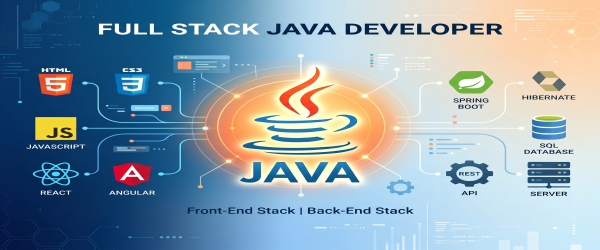
Advanced modules include JDBC-based database connectivity, Servlet and JSP lifecycle management, and enterprise backend development using Spring Boot and Hibernate ORM. Students design layered architectures, implement RESTful APIs, manage dependency injection, and build scalable, maintainable server-side applications.

Designed for aspiring developers and working professionals, this program develops applied competency in backend engineering, enterprise application development, and modern Java-based software systems.


JAVA(Core & Advance)
JAVA Core & Advanced — from fundamentals to enterprise

JAVA (Core & Advanced)

Master Java from the ground up through Core Java fundamentals, OOP principles, Collections Framework, Exception Handling, and Multithreading — then advance to enterprise-grade development with JDBC, Servlets, JSP, Spring Boot, Hibernate/JPA, REST APIs, and microservices architecture that powers real-world backend systems across banking, fintech, and enterprise software.

Certificate
You will get Medhavi Skills Certificate
Partnership
Insta Infotech × Medhavi Skills University
Recognition
NCrF aligned learning pathway
Java developer skill tiers
Core Java — OOP, Collections & Multithreading
JVM, classes, exceptions, generics, streams, and threads
Core
 
Advanced Java — JDBC, Servlets & Spring Boot
Database connectivity, web layer, REST APIs, and frameworks
Advanced
 
Enterprise Layer — Hibernate, Microservices & Cloud
ORM, Spring Cloud, Docker, and CI/CD deployment
Enterprise

Core, advanced, and enterprise — each tier built on the one before, toward one production-grade Java backend application.

 
Program overview

More than syntax and a Hello World.

This course covers the complete Java developer journey in one program — from JVM architecture, OOP, and Java 8+ features in Core Java, through database connectivity, Servlet-based web development, and Spring Boot REST APIs in Advanced Java, into Hibernate ORM, microservices, and deployment — so every student finishes with both the depth and breadth that enterprise Java roles demand.

01 / Two courses, one skill
Core + Advanced as one journey.

Core and Advanced Java are taught as a single progressive skill set — each advanced topic is grounded in the Core Java concept it extends, so nothing feels disconnected or suddenly complex.

02 / Think in enterprise architecture
From class design to microservices

Understand how a Java application grows from a single class to a Spring Boot service with a Hibernate-managed database, REST endpoints, and Docker-based deployment — the mental model of a working Java backend developer.

03 / Career signal
Portfolio and interview prep

Build Spring Boot REST APIs and Hibernate-backed applications for interviews across enterprise software, banking, fintech, product, and service company Java roles.

 
Learning journey

A clearer learning flow.

The progression moves from Core Java fundamentals and OOP, through Collections and Java 8+ features, into JDBC and database work, then Spring Boot REST APIs, Hibernate ORM, and a full enterprise-grade capstone project.

Step 01
Core Java Fundamentals
JVM/JDK/JRE architecture, syntax, data types, operators, control flow, arrays, strings, and methods.
Step 02
OOP, Collections & Java 8+
Inheritance, polymorphism, interfaces, abstract classes, Collections Framework, generics, exception handling, multithreading, lambda expressions, Streams API, and Optional.
Step 03
JDBC & Database Connectivity
JDBC architecture, connecting Java to MySQL/PostgreSQL, CRUD operations, PreparedStatement, and transaction management.
Step 04
Spring Boot & REST APIs
Spring Boot architecture, dependency injection, Spring MVC, building REST APIs, JSON serialisation, and Spring Security basics.
Step 05
Hibernate, Microservices & Capstone
Hibernate ORM, JPA, entity mapping, microservices intro, Docker basics, and capstone enterprise Java application.
 
Syllabus

Structured for job-relevant output.

Topics organized into clean thematic groups so the section feels premium and is easy to scan.

Core Java
  • JVM architecture, syntax, and OOP principles
  • Collections, generics, and exception handling
  • Multithreading, Java 8 lambdas, and Streams API
Advanced Java
  • JDBC — database connectivity and CRUD
  • Spring Boot — MVC, REST APIs, Security
  • Hibernate ORM — JPA, entity mapping, queries
Enterprise and launch
  • Microservices architecture and Spring Cloud intro
  • Docker basics and CI/CD deployment
  • Capstone enterprise Java application
 
Certification and recognition

Make the credential visible, not buried.

You will receive a Medhavi Skills Certificate. The program is presented through Insta Infotech's partnership with Medhavi Skills University, and the learning pathway is aligned with the National Credit Framework (NCrF).

Why this matters
 
Certificate visibility
Now highlighted in the hero and repeated in the certification block.
 
University partnership
Medhavi Skills University is treated as a trust signal, not a small footer note.
 
Recognition cue
NCrF alignment is framed as a formal learner benefit.

Module 1: Programming Fundamentals in Java
  • Introduction to Programming Concepts
  • Explain programming logic, algorithms, and OOP basics
  • Write simple Java programs using basic syntax
  • Features of Java
  • Describe features like platform independence, OOP, robustness
  • Demonstrate platform independence by compiling and running programs
  • Java Architecture (JDK, JRE, JVM)
  • Explain role of JDK, JRE, JVM and bytecode
  • Install JDK and configure environment variables
  • Installation & IDE Setup
  • Explain IDE tools and project structure
  • Create and execute projects using Eclipse/IntelliJ
  • Data Types & Variables
  • Differentiate primitive and non-primitive data types
  • Develop programs using variables and type casting
  • Operators in Java
  • Explain arithmetic, relational, logical operators
  • Write programs using operators for calculations
  • Conditional Statements
  • Explain decision-making constructs
  • Develop programs using if-else and switch
  • Looping Statements
  • Describe loop types and iteration logic
  • Write programs for pattern printing and series generation
  • Break & Continue
  • Explain loop control statements
  • Implement logic using break and continue
  • Arrays
  • Explain array declaration and memory allocation
  • Perform searching and sorting on arrays
  • String & StringBuffer
  • Explain immutable vs mutable strings
  • Develop string manipulation programs

Module 2: Object-Oriented Programming in Java
  • Classes & Objects
  • Define class, object, methods
  • Create classes and instantiate objects
  • Constructors
  • Explain constructor types
  • Implement parameterized and default constructors
  • Inheritance
  • Explain types of inheritance
  • Implement inheritance and method overriding
  • Polymorphism
  • Explain overloading and overriding
  • Develop polymorphic programs
  • Abstraction
  • Explain abstract classes and interfaces
  • Implement abstraction using abstract classes
  • Encapsulation
  • Explain data hiding and access modifiers
  • Implement encapsulation using getters/setters
  • Interfaces
  • Explain multiple inheritance through interfaces
  • Develop interface-based programs

Module 3: Exception Handling & Packages
  • Types of Exceptions
  • Differentiate checked and unchecked exceptions
  • Identify runtime and compile-time errors
  • Try-Catch-Finally
  • Explain exception handling flow
  • Implement try-catch blocks
  • Throw & Throws
  • Explain custom exception propagation
  • Develop programs using throw/throws
  • Custom Exceptions
  • Explain user-defined exceptions
  • Create and handle custom exceptions
  • Packages & Access Modifiers
  • Explain package structure and scope
  • Create and import user-defined packages

Module 4: Advanced Java Programming
  • Thread Life Cycle
  • Explain thread states
  • Demonstrate thread lifecycle through program
  • Creating Threads
  • Explain Thread class and Runnable interface
  • Create multithreaded programs
  • Synchronization
  • Explain synchronization concept
  • Implement synchronized methods
  • Java Collections Framework
  • Explain Collection hierarchy
  • Use ArrayList/ HashSet/ HashMap in programs
  • List Interface
  • Explain List implementations
  • Develop programs using ArrayList & LinkedList
  • Set Interface
  • Explain Set behavior
  • Implement HashSet and TreeSet
  • Map Interface
  • Explain key-value mapping
  • Implement HashMap operations

Module 5: Database Programming with Java
  • File Streams
  • Explain file input/output streams
  • Perform file read/write operations
  • Byte & Character Streams
  • Differentiate stream types
  • Develop programs using FileReader/FileWriter
  • Buffered Streams
  • Explain buffered I/O
  • Implement buffered reading/writing
  • Introduction to JDBC
  • Explain JDBC architecture
  • Load driver and establish DB connection
  • JDBC Architecture
  • Explain driver manager and connection interface
  • Create database connectivity program
  • Database Connectivity
  • Explain connection steps
  • Connect Java with MySQL database
  • CRUD Operations
  • Explain SQL operations
  • Perform insert, update, delete, select using JDBC

Module 6: GUI Development using Java
  • AWT Components
  • Explain AWT components
  • Create GUI using AWT
  • Swing Components
  • Explain Swing features
  • Design forms using Swing
  • Layout Managers
  • Explain layout types
  • Arrange components using layouts
  • Event Delegation Model
  • Explain event handling model
  • Implement event listeners
  • ActionListener & Event Listeners
  • Explain listener interfaces
  • Develop interactive GUI applications

Module 7: Web Development using Java
  • Introduction to Web Technologies
  • Explain client-server architecture
  • Deploy web app on Apache Tomcat
  • Servlet Life Cycle
  • Explain servlet phases
  • Develop basic servlet program
  • Handling Client Requests
  • Explain request-response model
  • Handle form data using servlets
  • JSP Basics
  • Explain JSP architecture
  • Create dynamic JSP pages
  • JSP Implicit Objects
  • Explain implicit objects
  • Develop JSP using built-in objects

Module 8: Project Work
  • Mini Project Planning
  • Explain project documentation & SDLC basics
  • Prepare project proposal
  • Application Development
  • Integrate Java concepts
  • Develop complete working application
  • Testing & Deployment
  • Explain testing and debugging
  • Deploy final project successfully

Send Me Message

Certificate and Accreditation

Accreditation Certificate

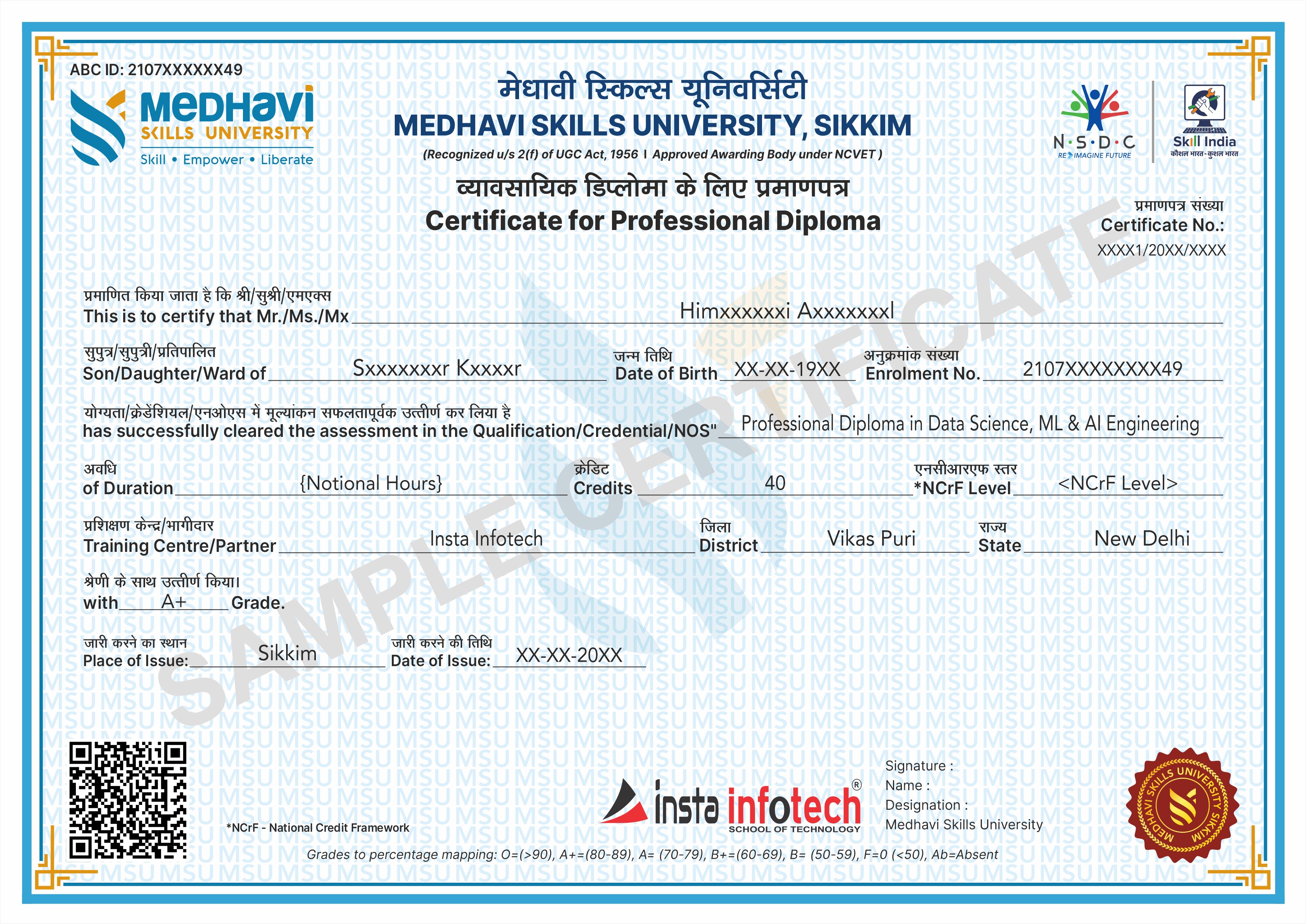
Professional Diploma Certificate

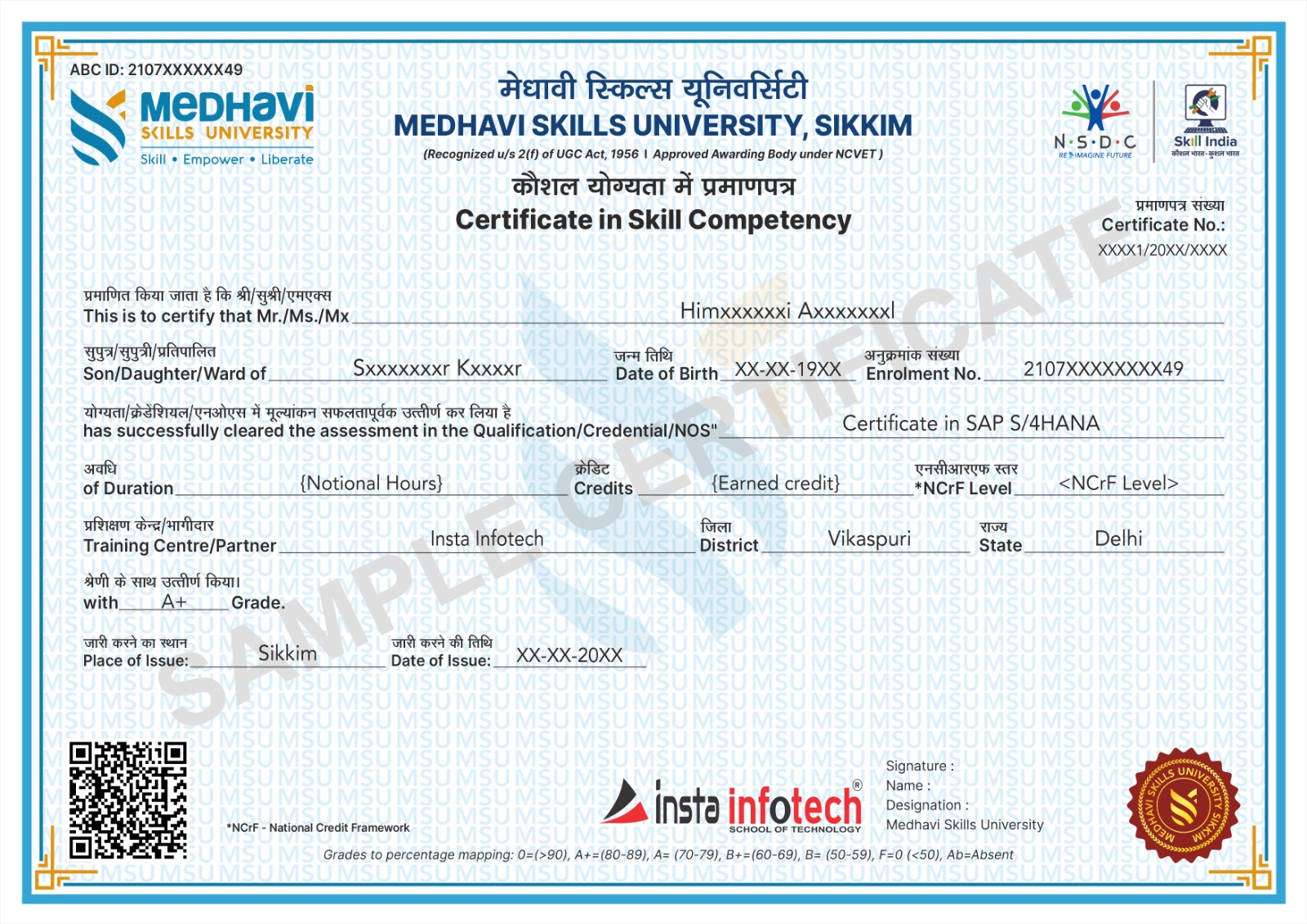
Skills Certificate

Brand Registration

Trust & Validation

UGC-Recognized Skilled Qualifications for the Modern Global Workforce

University Certification

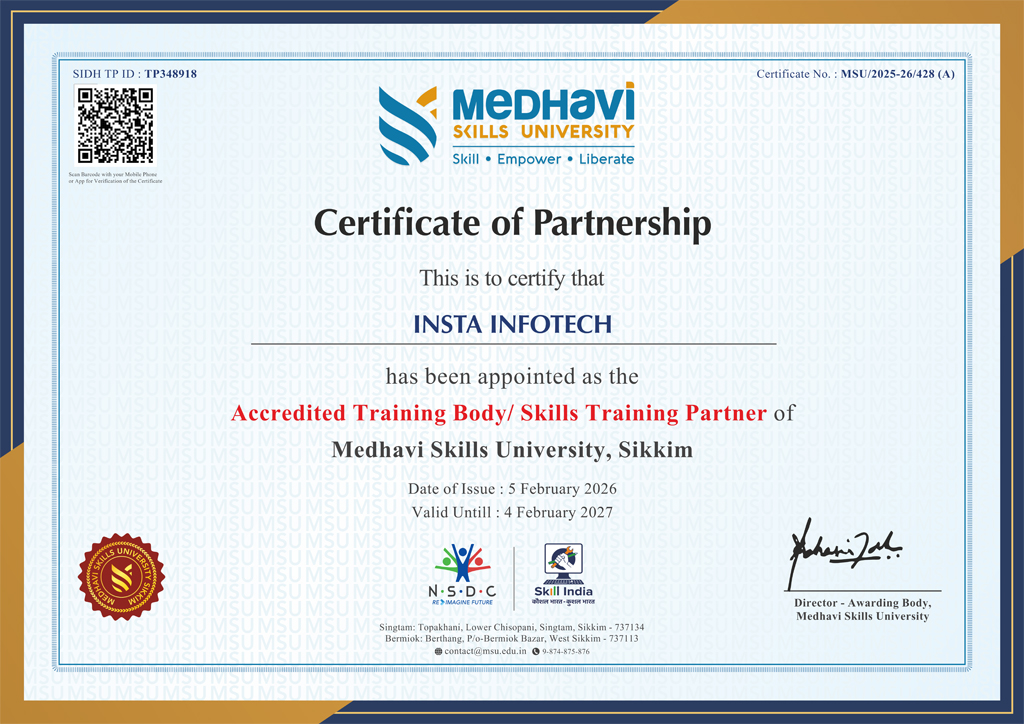
Earn industry-relevant Certificates and Diplomas awarded by Medhavi Skills University, a UGC-recognized University. Insta Infotech is Approved Training Partner of Medhavi Skills University, ensuring quality education and credible certification.

Certificate Verification

All Certificates and Diplomas are digitally verifiable through Government of India platforms, including Skill India Digital Hub (MSDE), ABC.gov.in (Ministry of Education), and DigiLocker, ensuring authenticity and nationwide recognition.

Credit-Based Course (NCrF)

Our courses are aligned with the National Credit Framework (NCrF) under the National Education Policy (NEP) 2020. Learners earn academic credits that strengthen their skill-based education profile and can be seamlessly transferred toward higher education pathways.

Global Recognition
Global Recognition

NCrF-aligned skill credits are recognized across the UK, EU, and Australian education systems. Through MSU’s global partnerships, learners benefit from dual certification opportunities and accelerated pathways to international degree programs.
Skill India Mission
Skill India Mission

Insta Infotech empowers learners with future-ready skills. Backed by the Skill India Mission and our academic partnership with Medhavi Skills University, we bridge the gap between education and employment through practical, hands-on learning and nationally recognized certifications.


Placement Support
Placement Support

Quality Skill Education — this is not merely a certificate of attendance, but a verified academic credential that enhances credibility and opens opportunities across MNCs, embassies, and government sectors.

Specializations

Skilled, Qualification, Certification

Course Credibility

Course Credibility

Our programs are certified by a recognized university, ensuring legal authenticity, academic validity, and strong professional acceptance. This means your qualification carries real value for employment, career advancement, and higher education.

Employability

Employability

Our programs combine practical training, real-world projects, and industry-relevant skills to prepare students for immediate employment. we ensure learners confidently transition from education to professional careers.

Global Standards

Global Standards

Our programs follow internationally aligned curricula and current industry requirements, ensuring learners gain globally relevant knowledge, practical competencies, and professional practices. This prepares students to adapt, compete, and work confidently.

National Alignment (Skill India)

National Alignment (Skill India)

Aligned with the Skill India Mission, we transform vocational training into a nationally recognized qualification, enabling our students to become part of India’s formal skilled workforce.

Academic Mobility (Credit-Based)

Academic Mobility (Credit-Based)

Through the National Credit Framework (NCrF), our courses are not merely extra-curricular; they are credit-earning modules that contribute directly toward your formal higher education pathway.

NEP 2020 Integration

NEP 2020 Integration

Aligned with the National Education Policy 2020, we transform traditional IT education into a multidisciplinary, skilled-based vocational pathway that enables students to earn formal academic credits.

Our Blogs

Latest Blog Updates

SEO Training Having Great Future Insta Infotech

Internet marketing is now flourishing throughout the world. The widespread use of internet has increased the market of products and services online. This has again increased the demand of online marketers.

Read More

Skillful Website with Developing Standards

If you are planning to choose a career in IT, here you find the career scope in joining Web designing course in Delhi.

Read More

Connect IT Training Peaks

Insta infotech “Software And IT Training Institute” makes an instrument to meet the twin challenges of continuous improvement in IT demand for change

Read More

Pick up High-Level Programming Language Python

Python is a High-level programming language. Python programming can be used for Data Science, Network Programming Web Development, etc. Our training covers python as object Oriented, Python as Data structure, GUI, Database connection with Python. Python is famous language as machine learning, course focus on  learning from beginning to advanced level.

Read More

Specialize in RHCSA certified Professional

Insta Infotech certified candidates with RHCSA practice course with 200+ RHEL7 real-world problem scenarios covering all the exam. An RHCSA® certification is earned when an IT professional try the core system administration skills required in Red Hat Enterprise Linux environments. To become an RHCSA certified, you need to pass the EX200 exam. Only this course has the up to date simulated tests questions, where all questions are carefully scrutinized by real Linux certified professionals.

Read More

Start Your Career As SEO Expert

Search Engine Optimization is one of the essential method you can make use of, attaining more higher rankings but also for running effective Search Engine Optimization campaigns.Today building a career in website development standards is the prime focus on all SEO methods, and also if it's not appropriately implemented. Professional and practical SEO courses in Delhi works on Live Projects that can provide you long-term gains in a shorter period.

Read More

Transform Your Career with Insta InfoTech - Premier IT Training Institute

Join Insta InfoTech for cutting-edge IT training programs designed to boost your skills and career prospects. Offering expert-led Courses in Software Development, Data Science, Cybersecurity, and more.

00+

Trained Students

00+

Years of Experience

00+

Countries Represented

00x7

Support

Insta Infotech

What We Offer

At Insta Infotech, we specialize in a wide array of courses across domains like:

Programming Languages: Java, Python, C++, .NET, and more. Data Science & Analytics: Machine Learning, AI, Big Data. Cloud Computing & DevOps: AWS, Azure, Docker, Kubernetes. Cybersecurity: Ethical Hacking, Network Security. Digital Marketing: SEO, Social Media, Content Marketing. Database Management: SQL, PL/SQL, MongoDB, Oracle.
Enquire Now
Our learners work at