All Courses

.NET Full Stack Developer Training – Master Frontend, Backend & Cloud Development

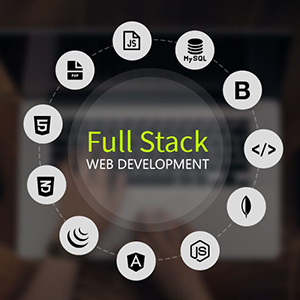
Become a versatile developer with Insta InfoTech®’s .NET Full Stack Developer Training, a comprehensive program designed to help you master both frontend and backend development using Microsoft technologies. This course covers everything from C# Programming, ASP.NET, and MVC for backend development to HTML, CSS, JavaScript, and React for frontend development, along with Database Integration using Entity Framework and SQL Server. Learn to build, deploy, and manage modern web applications, and prepare for high-demand roles like .NET Full Stack Developer, Software Engineer, and Web Developer. Earn a recognized .NET Full Stack Developer Certification and unlock exciting job opportunities in the IT industry.

.NET Full Stack Developer
  • Master Frontend Development: Learn HTML, CSS, JavaScript, and React to build interactive and responsive user interfaces.
  • Backend Development with .NET: Use C#, ASP.NET, and MVC to create robust and scalable backend systems.
  • Database Integration: Work with Entity Framework and SQL Server for seamless database management.
  • Cloud Deployment: Learn to deploy applications on Microsoft Azure and other cloud platforms.
  • Full Stack Integration: Build complete web applications by integrating frontend and backend systems.
  • Real-World Projects: Apply your skills to real-world projects in Web Development and Enterprise Applications.
  • Certification: Earn a recognized .NET Full Stack Developer Certification upon course completion.
Why Choose Insta InfoTech®?
  • Expert trainers with real-world experience in .NET Development and Full Stack Development.
  • Hands-on training with practical projects and case studies.
  • Flexible learning options (online and offline).
  • Placement assistance to help you land roles like .NET Full Stack Developer, Software Engineer, and Web Developer.
  • Lifetime access to course materials and support.
Who Should Enroll?
  • Aspiring .NET Full Stack Developers and Software Engineers.
  • IT Professionals looking to upskill in .NET Development and Full Stack Development.
  • Graduates seeking a career in Web Development and Enterprise Applications.
  • Anyone interested in mastering C#, ASP.NET, React, and Cloud Deployment for building modern applications.
Job Opportunities

Upon completing the .NET Full Stack Developer Training, you will be prepared for a variety of high-demand roles, including:

  • .NET Full Stack Developer: Build and maintain both frontend and backend systems for web applications.
  • Software Engineer: Design and build scalable software solutions using .NET technologies.
  • Web Developer: Create dynamic and responsive web applications using ASP.NET and React.
  • Cloud Developer: Deploy and manage applications on cloud platforms like Microsoft Azure.
  • Backend Developer: Develop server-side logic and database integration for web applications.
Transform Your Career Today!

Join Insta InfoTech®’s .NET Full Stack Developer Training and become a skilled full stack developer. Gain the expertise to build, deploy, and manage modern web applications, and open doors to exciting job opportunities in the IT industry.

Module-1 .NET Introduction
  • Differences between Programming Languages
  • Platform Dependency Vs Platform Independency
  • .NET Languages & Compilers
  • CIL/MSIL code
  • Language Interoperability
Module-2 .NET Runtime
  • .NET Framework
  • .NET Core, .NET 5, and .NET 6
  • Architecture of .NET Runtime
  • Managed and Un-Managed Code
  • CLI Specifications
  • Versions of .NET Runtime
  • .NET Class Libraries (FCL & CORE FX)
Module-3 CLR
  • Security Manager
  • JIT Compiler
  • Garbage Collector
Module-4 Introduction to C#
  • History of C#
  • Versions and Features
  • Procedural Programming Approach
  • Object Oriented Programming Approach
  • Structure of a program in C
  • Structure of a program in C++
  • Structure of a program in Java
  • Structure of a program in C#
Module-5 Writing the 1st Program using C#
  • Rules to be followed
  • Saving the C# code in Notepad
  • Compiling C# Programs thru Developer Command Prompt
  • Executing compiled code thru Developer Command Prompt
Module-6 C# Data Types
  • Integer Types
  • Float, Double, Decimal Types
  • Boolean Type
  • DateTime Type
  • GUID Type
  • Char & String Types
  • Object Type
Module-7 Variables & Fields
  • Syntax of Variable & Field Declarations
  • Value Types Vs Reference Types
  • Nullable Value Types
  • Implicitly Typed Variables
  • Dynamic Type
  • Boxing Vs Un-Boxing
Module-8 Conditional Statements
  • Conditional Branching
  • Conditional Looping
  • Jump Statements
Module-9 Arrays
  • Single Dimensional Arrays
  • Array Class
  • Two Dimensional Arrays
  • Jagged Arrays
  • Implicitly Typed Arrays
  • Command Line Arguments
Module-10 Working with Visual Studio
  • Versions of Visual Studio IDE
  • Project Templates
  • Item Templates
  • Solution Explorer
  • Compilation
  • Execution
Module-11 Encapsulation
  • Sub Programs
  • Method Syntax
  • Parameter less Methods
  • Parameterized Methods
  • Non-Value Returning Methods
  • Value Returning Methods
  • In, Out and InOut Parameters
  • Params Keyword
  • Default Valued Parameters
  • Instance Creation
  • Difference between Instance, Variable & Reference of a class
  • De-referencing the instance of class
  • Multiple instances of a class
  • Constructors
  • Static Keyword
  • Case Study
Module-12 Inheritance
  • Implementation
  • Accessing parent members from child class
  • Creating parent class Reference by using child class Instance
  • Creating child class Reference by using parent class Reference
  • Default parent class
  • Types of Inheritance
  • Passing values to parent class constructor using child class instance
  • Case Study
Module-13 Polymorphism
  • Method Overloading
  • Inheritance based Overloading
  • Method Overriding
  • Hiding/Shadowing
  • Constructor Overloading
  • Operator Overloading
  • Types of Polymorphism
  • Sealed Classes & Methods
Module-14 Abstract Classes & Methods
  • Abstract methods & classes declaration
  • Need and advantages of Abstract Classes
  • Case Study
Module-15 Interface
  • Need of an Interface
  • Multiple Inheritance with Interfaces and Case Study
Module-16 Structure
  • Declaration and Implementation of a Structure
  • Differences between Structure and Class
Module-17 Extension Methods
  • Need and advantages of Extension Methods
  • Adding extension methods to user-defined and pre-defined types
Module-18 Solution & Projects
  • Application Architecture in Real-time Applications
  • Hierarchy of solutions and projects
  • Organizing solutions by adding new and existing projects
  • Project compilation and Assemblies
Module-19 Assemblies
  • .dll Assemblies
  • .exe Assemblies
  • Difference between assemblies
  • .NET Framework, .NET Core and .NET 5 Assembly organization
Module-20 Access Specifiers
  • Need and use of Access Specifiers
  • Types of access specifiers and their scope.
Module-21 Language Interoperability
  • What is Language Interoperability
  • Consuming C# Assemblies in VB Projects
  • Consuming VB Assemblies in C# Projects
Module-22 Miscellaneous members of a class
  • Finalizers
  • Properties
  • Indexers
  • Deconstructors
Module-23 Enum Type
  • What is an Enum
  • Definition and Consumption of Enums
Module-24 Exceptions & Exception Handling
  • What is an Exception
  • Exception class hierarchy
  • Need of Exception Handling
  • Try, Catch & Finally
  • Throwing Exceptions
  • System Exceptions
  • Application Exceptions
  • User-defined Exception Class
Module-25 Delegate Type
  • What is a delegate and where we use?
  • Defining delegates
  • Multicast Delegates
  • Anonymous Methods
  • Lambda Expressions
  • Expression bodied Members
Module-26 Miscellaneous Concepts
  • Anonymous Types
  • Partial Classes
  • Partial Methods
Module-27 Collections
  • Stack
  • Queue
  • Array List
  • Hash Table
  • Generics & Generic Collections
  • List, Dictionary, and other Collection classes
Module-28 LINQ
  • What is LINQ
  • LINQ Vs SQL, LINQ to Objects, LINQ to Databases, LINQ to XML
  • Implementing LINQ on Arrays, Collections & Objects
Module-29 Windows Programming
  • Introduction to GUI Programming
  • Controls – Properties, Methods and Events
  • Working with Form Control
  • Delegates, Events and Event Handlers
  • Button, TextBox, Radio Button and CheckBox Controls
  • Combo Box, ListBox and Checked ListBox Controls
  • Dialog Controls – Color Dialog, Font Dialog, Open File Dialog, Save File Dialog and Folder Browser Dialog
  • Image and Timer Controls
  • Creating Menu’s and Menu Item’s
  • MDI and Layout’s
  • User Controls
Module-30 Accessing Data with ADO.NET
  • ODBC Drivers
  • OLEDB and Framework Providers
  • ADO Vs ADO.NET
  • Introduction To ADO.NET Technology
  • Communication with Data Sources
  • Connected Architecture
  • Disconnected Architecture
  • DataReader Vs DataSet
  • Connection Strings and Configuration Files
  • DataTable, DataRow, DataColumn, DataView and DataRelation Classes
  • Working with Stored Procedures
  • Data Binding with Data Source Controls – GridView and DataGrid
Module-31 Assemblies
  • Private Assemblies
  • Shared Assemblies
  • Global Assembly Cache
  • Versioning of Assemblies
  • Contents of an Assembly file
Module-32 Task Parallel Library (TPL)
  • Task Vs Threads
  • Asynchronous Programming
  • Calling methods with Tasks
  • Thread Synchronization
  • Data Parallelism with Parallel.For and Parallel.ForEach
  • Task chaining using continuation Tasks
  • Task cancellation using cancellation tokens
  • Async and Await

Module-1 Introduction to Web Applications
  • Windows Applications Vs Web Applications Vs Distributed Applications
  • ASP.NET Vs ASP.NET Core
  • Client/Server Architecture Application
  • What are Client and Server
  • Role of Web Server
  • IIS (Internet Information Services)
  • Creating a new Website on IIS
Module-2 ASP .NET Technology
  • Classical ASP
  • Drawback Of classical ASP
  • Evolution Of ASP.NET - Web Forms
  • Evolution Of ASP.NET - MVC
  • Introduction to MVC
  • Introduction to Design Patterns
  • Architecture Patterns
Module-3 Intro to MVC
  • ASP.NET Web Forms (Vs) ASP.NET MVC
  • List of Versions of ASP.NET MVC
  • MVC Architecture, what is MVC?
  • What is Controller and Action Method
  • What is View & What is Model
  • Request Flow in ASP.NET MVC

Module-1 Project Creation
  • Creating New Project in Visual Studio
  • Overview of Folders and files of MVC project
Module-2 Controllers
  • Introduction
  • Creating Controllers Manually and by using Scaffolding
  • Action Methods in Controllers
  • Parameters to Action methods
Module-3 URL Routing
  • Overview
  • Need of URL Routing, Parameters in URL
  • Default Parameter Values
  • Literals in URL
Module-4 Views
  • Introduction
  • Action Results and various types of Action Results
  • Action Methods returning Action Results
  • Creating a Razor View
  • Shared Views
  • View Engines
  • ASPX View Engine Vs Razor View Engines
  • Razor Programming
Module-5 Passing Data from Controller to View
  • View Data
  • View Bag
  • Temp Data
  • Sessions
  • Anonymous Methods
  • Strongly Typed Models
Module-6 UI Designing
  • With HTML Controls
  • With HTML Helpers
  • With Strongly Typed HTML Helpers
Module-7 Partial Views
  • Need of Partial Views
  • Development and Consumption of Partial Views
  • Html.Partial
  • Html.RenderPartial
  • Html.RenderAction
Module-8 Layout Views
  • Introduction and need of Layout Views
  • Default Layout View (_Layout.cshtml)
  • Creating custom Layout Views
  • Layout Views with Sections
  • Html.RenderSection()
  • _ViewStart.cshtml
  • Overriding _ViewStart.cshtml
Module-9 Bundling And Minification
  • Need of Minification and Bundling
  • BundleConfig.cs
  • ScriptBundles and StyleBundles
  • Importing ScriptBundles and StyleBundles
  • Creating and consuming custom bundles
Module-10 Areas in MVC
  • What is an Area in MVC Application?
  • Need and creation of MVC Area
  • Area Registration and Configuration
Module-11 Data Annotations and Validations
  • Introduction
  • Model level validations (vs) View level validations
  • Importing jQuery Validation Plug in
  • [Required], [RegularExpression]
  • [Range], [StringLength], [Compare]
  • [Remote], ModelState.IsValid, Custom Validations
  • [Display], [Datatype], [DisplayFormat], [ScaffoldColumn]
Module-12 LINQ to SQL
  • Introduction to LINQ
  • What is LINQ to SQL
  • Performing CRUD Operation using LINQ to SQL
Module-13 ADO.NET Entity Framework (EF)
  • Introduction to Entity Framework
  • Various Approaches in EF
  • Understanding DbContext and DbSet
  • Entity Framework DB First
  • Entity Framework Code First
  • Entity Framework Model First
Module-14 Scaffold Templates
  • Need of Scaffolding
  • Creating controllers and views using scaffold
  • Understanding Index, Details, Create, Edit, Delete action methods and views
Module-15 Filters
  • Introduction to Filters
  • ChildActionOnly, OutputCache, ValidateInput
  • ValidateAntiForgeryToken, HandleError
  • Action Filters, Result Filters, Authorization Filters
  • Exception Filters, Custom Filters
  • Authentication and Authorization
  • Types of Authentications
  • AllowAnonymous
Module-16 JQuery and Ajax in MVC
  • Introduction and need of JQuery in MVC
  • Importing/Updating JQuery plug in and Demos
  • Implementing Auto fill Textbox's using JQuery AJAX
  • JTable and MVC Grid Controls
Module-17 Web API
  • Introduction to distributed applications
  • Web Services Vs WCF Vs Web API
  • Understanding HTTP Methods (GET, POST, PUT, DELETE)
  • Creating API Controller and API configuration
  • Calling Web API from JQuery
  • CRUD operations using JQuery AJAX with Web API
  • Enabling CORS
  • Consuming Web API from MVC Project
Module-18 Developing Single Page Applications
  • What is SPA
  • Need of SPA and Getting started
  • Angular Integration

Module-1 Introduction to .NET CORE
  • What is .NET CORE
  • What’s new in.NET core
  • ASP.NET core
  • .NET Core Vs ASP.NET Core
Module-2 ASP.NET CORE MVC Applications
  • Introduction
  • Setting up a new project
  • Command line tools and code
  • ASP.NET Core MVC project structure
  • Program and Stratup Classes
  • Main method in ASP.NET Core Applications
Module-3 Startup and Middleware’s
  • Introduction
  • How Middleware Works
  • Configure and Configure Services Methods
  • Exception Handling Middleware
  • Routing Middleware
  • Static Files Middleware
  • Setting up ASP.NET MVC Middleware
Module-4 Hosting Models
  • What are Hosting Models
  • Types of Hosting Models
  • Kestrel Web Server
  • Reverse Proxy Servers
Module-5 Controllers in MVC Framework
  • Introduction
  • MVC design pattern
  • Routing
Module-6 Views in MVC Framework
  • Creating Simple Views
  • Tag Helpers for creating Views
  • Built-in Tag Helpers
  • Custom Tag Helpers
Module-7 Models in MVC Framework
  • Introduction
  • Models and Views
  • Entity Framework CORE
  • Introduction
  • Installing EF Core
  • EF Core Architecture and Libraries
  • Creating and Implementing DB Context
  • Configuring EF Services
  • Entity Framework Migrations
  • Various Approaches in EF (DB First and Code First)
  • Creating CRUD Application in MVC Core using DB First
  • Creating CRUD Application in MVC Core using Code First
  • Dependency Injection Introduction
  • Dependency Injection Containers
  • Integrated support of Dependency Injection in ASP.NET Core
  • Implementing Dependency Injection in MVC Core Applications
Module-8 Error Handling In MVC Core Applications
  • Handling Client Errors
  • Handling Server Errors
Module-9 ASP.NET CORE Identity
  • Introduction to Identity Framework
  • Authentication Services and Middleware
  • Identity in ASP.NET Core MVC
  • Open Authentication
  • Authorization
Module-10 WEB API Core
  • Creating a WEB API Core Service
  • Testing WEB API Core Services using Swagger
  • Implementing Dependency Injection in WEB API Core
  • Consuming WEB API Core Service in MVC CORE using JQUERY
  • Consuming WEB API Core Service in MVC CORE using C#
Module-11 Publish/Hosing and MVC Core Application
  • What is Publish/Host
  • Types of Publishing/Hosting options
  • File System Vs Web Deploy Vs App Service
  • Hosting MVC Core Application on Microsoft Azure
  • Summarizing the whole proces

Send Me Message

Trust & Validation

UGC-Recognized Skilled Qualifications for the Modern Global Workforce

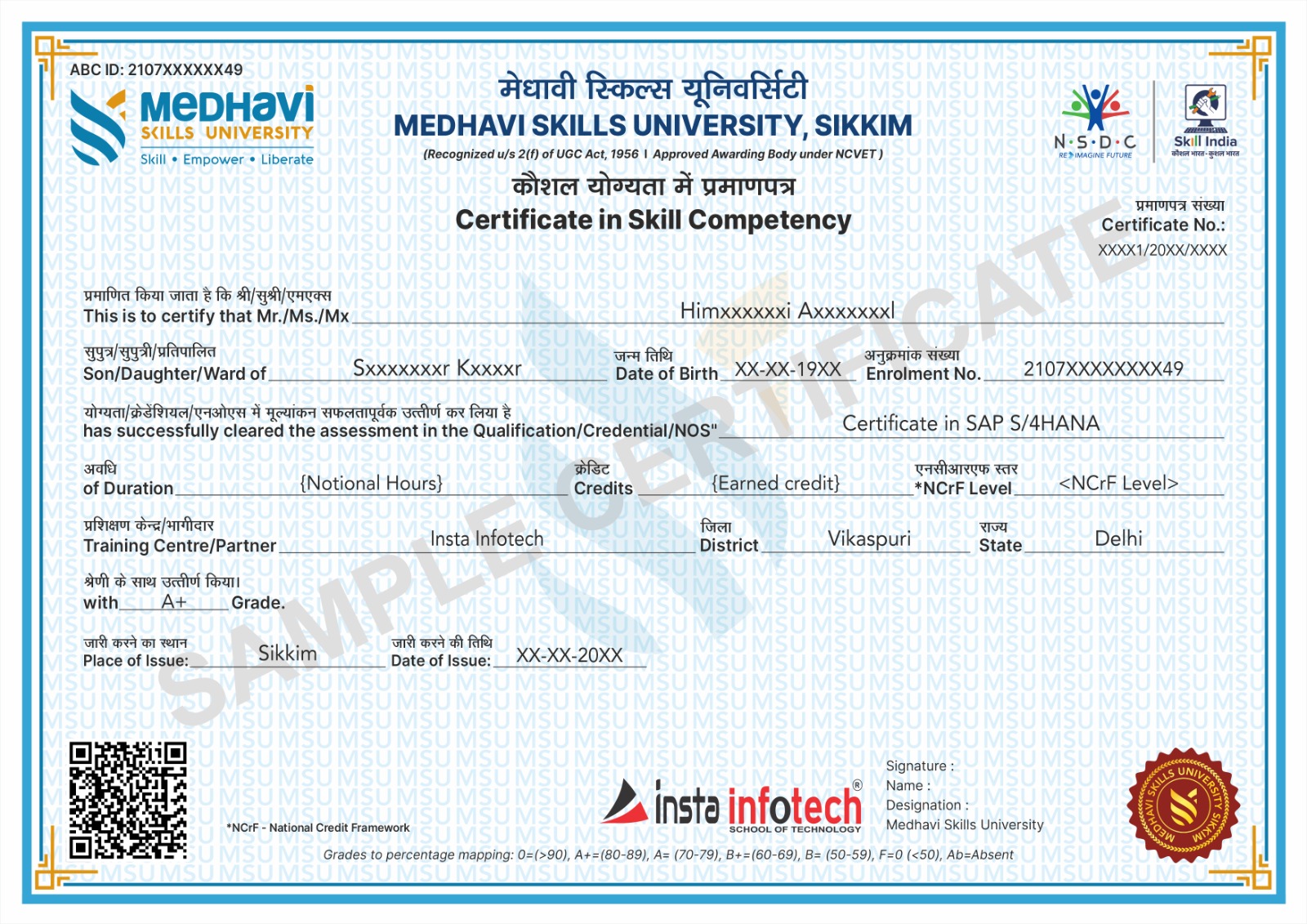
University Certification

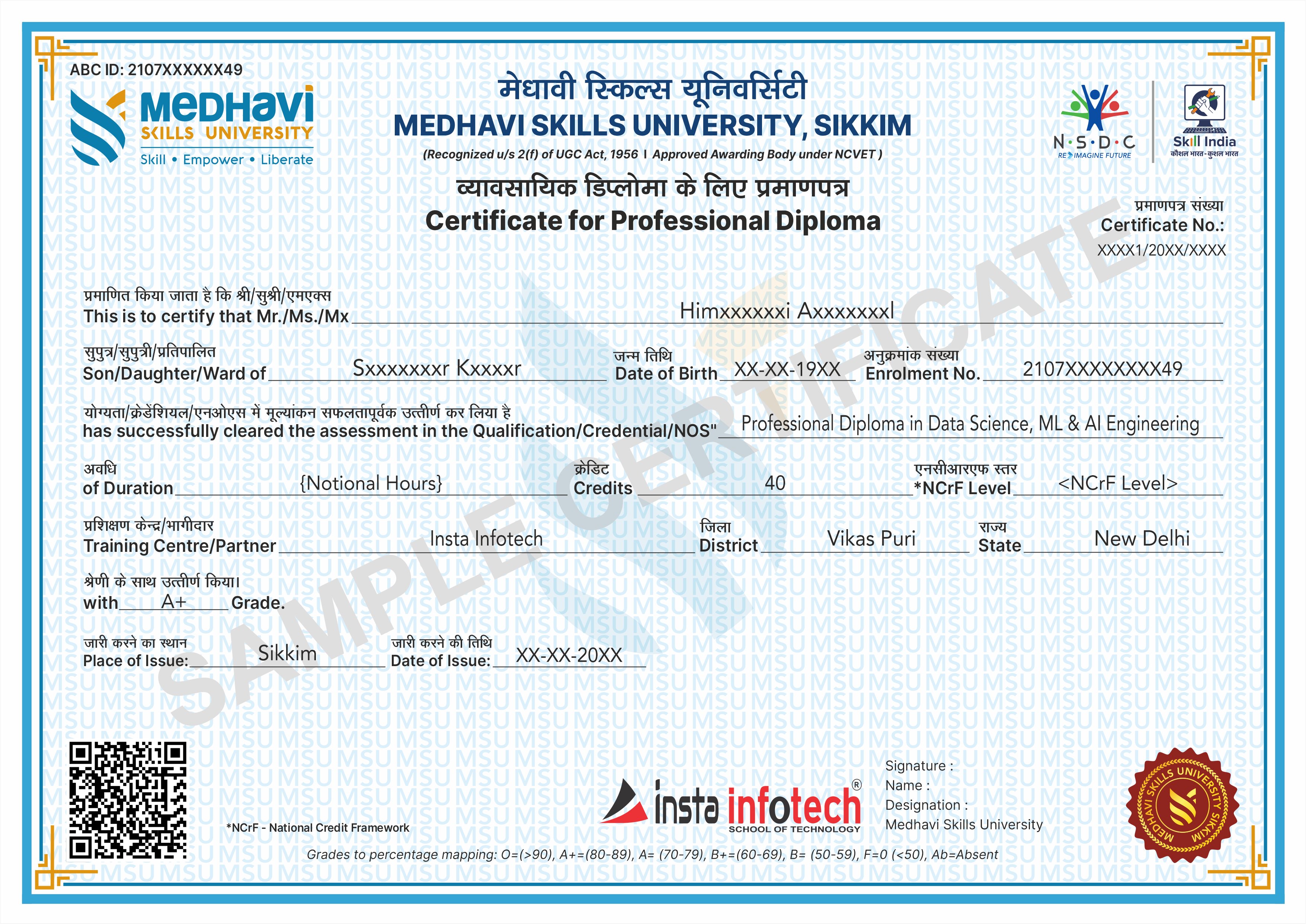
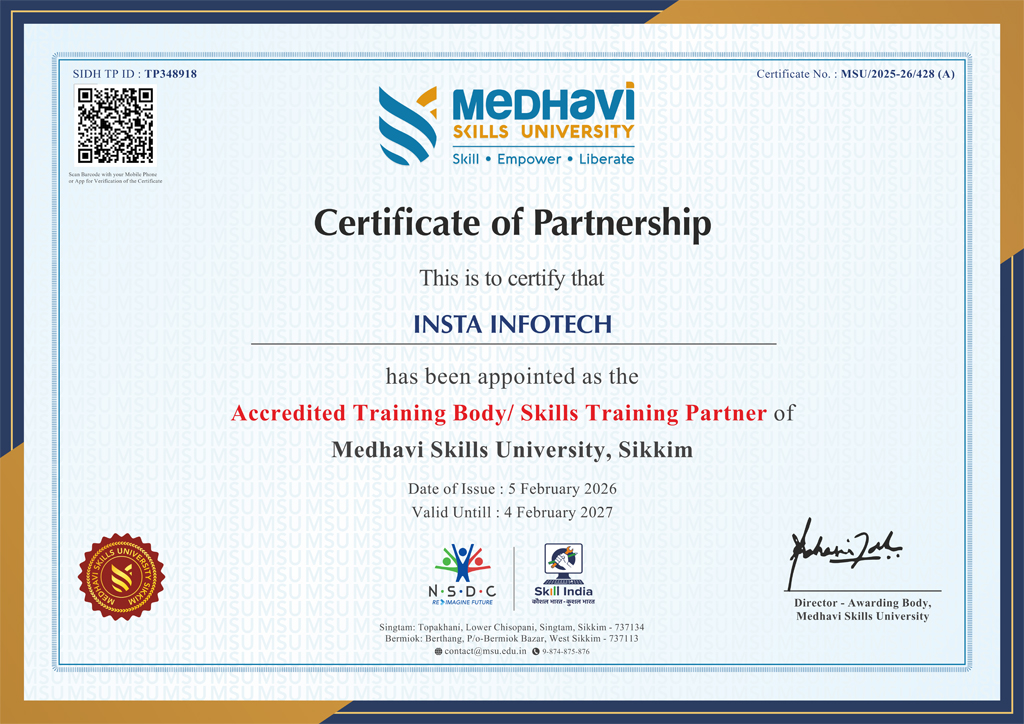
Earn industry-relevant Certificates and Diplomas awarded by Medhavi Skills University, a UGC-recognized University. Insta Infotech is Approved Training Partner of Medhavi Skills University, ensuring quality education and credible certification.

Certificate Verification

All Certificates and Diplomas are digitally verifiable through Government of India platforms, including Skill India Digital Hub (MSDE), ABC.gov.in (Ministry of Education), and DigiLocker, ensuring authenticity and nationwide recognition.

Credit-Based Course (NCrF)

Our courses are aligned with the National Credit Framework (NCrF) under the National Education Policy (NEP) 2020. Learners earn academic credits that strengthen their skill-based education profile and can be seamlessly transferred toward higher education pathways.

Global Recognition
Global Recognition

NCrF-aligned skill credits are recognized across the UK, EU, and Australian education systems. Through MSU’s global partnerships, learners benefit from dual certification opportunities and accelerated pathways to international degree programs.

Skill India Mission
Skill India Mission

Insta Infotech empowers learners with future-ready skills. Backed by the Skill India Mission and our academic partnership with Medhavi Skills University, we bridge the gap between education and employment through practical, hands-on learning and nationally recognized certifications.

Placement Support
Placement Support

Quality Skill Education — this is not merely a certificate of attendance, but a verified academic credential that enhances credibility and opens opportunities across MNCs, embassies, and government sectors.

Specializations

Skilled, Qualification, Certification

Course Credibility

Course Credibility

Our programs are certified by a recognized university, ensuring legal authenticity, academic validity, and strong professional acceptance. This means your qualification carries real value for employment, career advancement, and higher education.

Employability

Employability

Our programs combine practical training, real-world projects, and industry-relevant skills to prepare students for immediate employment. we ensure learners confidently transition from education to professional careers.

Global Standards

Global Standards

Our programs follow internationally aligned curricula and current industry requirements, ensuring learners gain globally relevant knowledge, practical competencies, and professional practices. This prepares students to adapt, compete, and work confidently.

National Alignment (Skill India)

National Alignment (Skill India)

Aligned with the Skill India Mission, we transform vocational training into a nationally recognized qualification, enabling our students to become part of India’s formal skilled workforce.

Academic Mobility (Credit-Based)

Academic Mobility (Credit-Based)

Through the National Credit Framework (NCrF), our courses are not merely extra-curricular; they are credit-earning modules that contribute directly toward your formal higher education pathway.

NEP 2020 Integration

NEP 2020 Integration

Aligned with the National Education Policy 2020, we transform traditional IT education into a multidisciplinary, skilled-based vocational pathway that enables students to earn formal academic credits.

Our Blogs

Latest Blog Updates

SEO Training Having Great Future Insta Infotech

Internet marketing is now flourishing throughout the world. The widespread use of internet has increased the market of products and services online. This has again increased the demand of online marketers.

Read More

Skillful Website with Developing Standards

If you are planning to choose a career in IT, here you find the career scope in joining Web designing course in Delhi.

Read More

Connect IT Training Peaks

Insta infotech “Software And IT Training Institute” makes an instrument to meet the twin challenges of continuous improvement in IT demand for change

Read More

Pick up High-Level Programming Language Python

Python is a High-level programming language. Python programming can be used for Data Science, Network Programming Web Development, etc. Our training covers python as object Oriented, Python as Data structure, GUI, Database connection with Python. Python is famous language as machine learning, course focus on  learning from beginning to advanced level.

Read More

Specialize in RHCSA certified Professional

Insta Infotech certified candidates with RHCSA practice course with 200+ RHEL7 real-world problem scenarios covering all the exam. An RHCSA® certification is earned when an IT professional try the core system administration skills required in Red Hat Enterprise Linux environments. To become an RHCSA certified, you need to pass the EX200 exam. Only this course has the up to date simulated tests questions, where all questions are carefully scrutinized by real Linux certified professionals.

Read More

Start Your Career As SEO Expert

Search Engine Optimization is one of the essential method you can make use of, attaining more higher rankings but also for running effective Search Engine Optimization campaigns.Today building a career in website development standards is the prime focus on all SEO methods, and also if it's not appropriately implemented. Professional and practical SEO courses in Delhi works on Live Projects that can provide you long-term gains in a shorter period.

Read More

Transform Your Career with Insta InfoTech - Premier IT Training Institute

Join Insta InfoTech for cutting-edge IT training programs designed to boost your skills and career prospects. Offering expert-led Courses in Software Development, Data Science, Cybersecurity, and more.

00+

Trained Students

00+

Years of Experience

00+

Countries Represented

00x7

Support

Insta Infotech

What We Offer

At Insta Infotech, we specialize in a wide array of courses across domains like:

Programming Languages: Java, Python, C++, .NET, and more. Data Science & Analytics: Machine Learning, AI, Big Data. Cloud Computing & DevOps: AWS, Azure, Docker, Kubernetes. Cybersecurity: Ethical Hacking, Network Security. Digital Marketing: SEO, Social Media, Content Marketing. Database Management: SQL, PL/SQL, MongoDB, Oracle.
Enquire Now
Our learners work at