All Courses

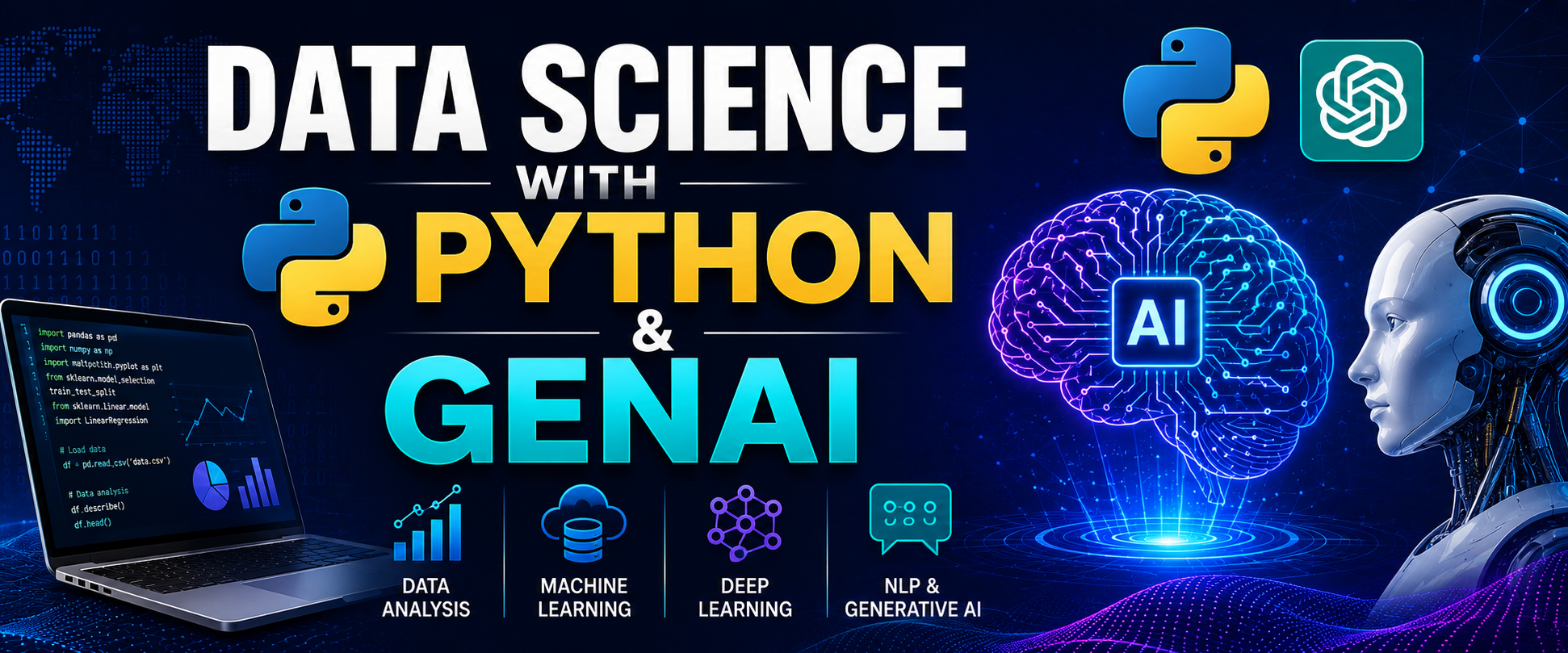
Professional Diploma in Data Science, ML & AI Engineering "Medhavi Skills University"

Step into the data-driven economy with Insta InfoTech®’s Professional Diploma in Data Science, AI & Machine Learning, a professionally designed program created for learners seeking recognized academic credit and industry-relevant skills.

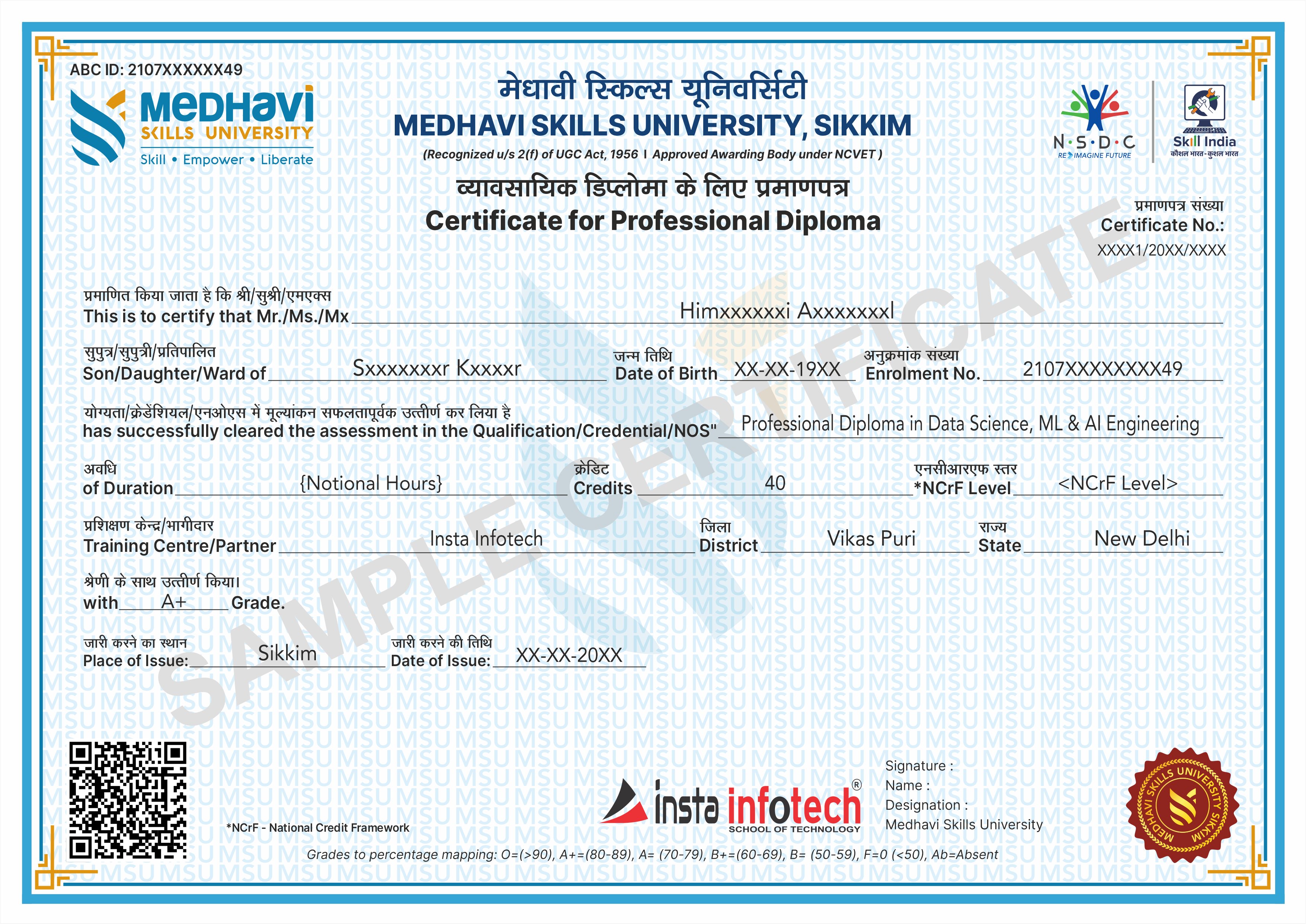
This diploma carries 40 academic credits aligned with India’s National Credit Framework (NCrF), enabling learners to strengthen their formal education profile while building job-ready expertise in data science, machine learning, and artificial intelligence.

The curriculum spans the full applied AI lifecycle — from Python programming and data analysis to machine learning models, deep learning, natural language processing (NLP), and computer vision. Learners gain hands-on experience using modern industry tools such as TensorFlow, PyTorch, and Scikit-Learn, supported by real-world projects and guided mentorship.

Whether you are a graduate, working professional, or career-switcher, this university-level diploma in data science and AI is designed to help you move confidently toward roles in data analytics, AI engineering, machine learning development, and applied research.

Professional Diploma in AI & Data Science


Advanced Diploma Program

Diploma in Data Science, ML & AI Engineering

Insta Infotech® offers a comprehensive, career-focused Diploma in Data Science, Machine Learning, and AI Engineering — covering statistics, Python programming, data analysis, predictive modelling, deep learning, and real-world AI application development in a single structured program.

Diploma Level Program
University-Recognised Certificate
NCrF Credits Included
Placement Support
Data Science
Analysis & Visualisation
Machine Learning
Predictive Modelling
AI Engineering
Deep Learning & LLMs
Overview

About This Diploma

Data Science, Machine Learning, and Artificial Intelligence are among the most sought-after disciplines in the global technology industry. This diploma program provides a structured, hands-on pathway that takes learners from the fundamentals of data handling and statistics through to building, training, and deploying real machine learning and AI models.

The program is built around Python — the dominant language in the data and AI ecosystem — and covers the full pipeline of a data science project: from raw data collection and cleaning, through exploratory analysis, model selection, training and evaluation, all the way to deployment and monitoring in production environments. Graduates leave with a portfolio of projects that demonstrate practical, employer-ready capability.

Data Science
Extracting actionable insights from data using statistical methods, Python libraries, and visualisation tools.
Machine Learning
Building algorithms that learn patterns from data to make predictions, classifications, and automated decisions.
Deep Learning
Neural network architectures — CNNs, RNNs, Transformers — that power computer vision, NLP, and generative AI.
AI Engineering
Deploying, serving, and monitoring ML models in production using APIs, containers, and cloud platforms.
The Process

The Data Science Pipeline


Data Collection
APIs, scraping, databases, CSV files
 
 
Data Cleaning
Handle missing values, outliers, formats
 
 
EDA
Explore patterns, distributions, correlations
 
 
Feature Engineering
Transform and select variables for models
 
 
Model Training
Build and fit ML algorithms on data
 
 
Evaluation
Accuracy, precision, recall, F1, AUC
 
 
Deployment
Flask, FastAPI, Docker, cloud platforms
What You Will Learn

Course Focus Areas

From Python programming and statistics through to neural networks and large language models — every focus area is reinforced through real datasets and applied projects.

 
Foundation
Python for Data Science
 

Python is the universal language of data and AI. This area ensures you are confident writing clean, efficient Python code and using the core scientific libraries before applying them to real problems.

 
Python syntax, data structures and OOP
 
NumPy for numerical computing
 
Pandas for data manipulation
 
Jupyter Notebooks and reproducible code
 
File I/O, APIs and web scraping basics
 
Analysis
Statistics & EDA
 

Understanding the data before modelling it is what separates good data scientists from bad ones. This area builds strong statistical intuition and exploratory analysis skills using real-world datasets.

 
Descriptive statistics and probability
 
Distributions, hypothesis testing, p-values
 
Correlation and covariance analysis
 
Matplotlib and Seaborn visualisations
 
Plotly and interactive dashboards
 
Machine Learning
ML Algorithms
 

The core of the program. Learn to build, evaluate, and tune a wide range of supervised and unsupervised machine learning models using Scikit-learn and real industry datasets.

 
Linear and logistic regression
 
Decision trees and random forests
 
SVM, KNN and Naive Bayes
 
XGBoost and gradient boosting
 
K-Means, PCA and clustering methods
 
AI Engineering
Deep Learning & LLMs
 

Go beyond classical ML into neural networks and modern AI. Build image classifiers, sequence models, and work with large language models using TensorFlow, Keras, and the Hugging Face ecosystem.

 
ANNs, CNNs and RNNs with Keras
 
Transfer learning and fine-tuning
 
Transformer architecture and attention
 
Hugging Face and pre-trained LLMs
 
Prompt engineering and RAG basics
Curriculum

Detailed Syllabus

Ten structured modules progressing from Python basics through to deploying production AI models — each with practical assignments, real datasets, and project deliverables.

01
Python Programming for Data Science
Python · NumPy · Pandas · Jupyter

Every data science and AI tool in this program runs on Python. This module builds solid programming fundamentals — from syntax and data structures through to working with the NumPy and Pandas libraries that form the backbone of all data work in Python.

Python variables, loops and functions
Lists, dicts, sets and comprehensions
Object-oriented programming basics
NumPy arrays, broadcasting, operations
Pandas DataFrames — load, filter, merge
Jupyter Notebooks and virtual environments
02
Statistics & Probability for ML
Descriptive Stats · Distributions · Hypothesis Testing

Machine learning is applied mathematics. This module ensures you understand the statistical concepts that underpin every algorithm you will use — from understanding your data's distribution through to validating model results with statistical confidence.

Mean, median, variance and standard deviation
Normal, binomial and Poisson distributions
Conditional probability and Bayes theorem
Hypothesis testing, t-test, chi-square
Correlation, covariance and p-values
Central limit theorem and sampling
03
Data Wrangling & Exploratory Analysis
Pandas · Cleaning · EDA · Visualisation

Real-world data is always messy. This module teaches you how to collect, clean, and explore datasets — one of the most time-consuming and critical parts of any data science workflow. You will work with real datasets including CSV, JSON, and database exports.

Handling missing values and duplicates
Outlier detection and treatment
Merging, joining and reshaping data
Matplotlib and Seaborn plots
Plotly for interactive visualisations
EDA report generation with Pandas Profiling
04
Supervised Machine Learning
Regression · Classification · Scikit-learn · Model Evaluation

The largest module in the program. Supervised learning covers algorithms that learn from labelled data to make predictions. You will build end-to-end ML pipelines using Scikit-learn — from feature preprocessing through model training, evaluation, and hyperparameter tuning.

Linear and polynomial regression
Logistic regression and classification
Decision trees and random forests
SVM and KNN algorithms
XGBoost and gradient boosting
Cross-validation and GridSearchCV
Accuracy, precision, recall, F1, AUC-ROC
Scikit-learn pipelines and preprocessing
05
Unsupervised Learning & Dimensionality Reduction
Clustering · PCA · Anomaly Detection

Not all data comes with labels. Unsupervised learning lets you discover hidden structure in data without predefined outcomes — critical for customer segmentation, recommendation systems, anomaly detection, and data compression tasks.

K-Means and hierarchical clustering
DBSCAN for density-based clustering
PCA and dimensionality reduction
t-SNE for high-dimensional visualisation
Anomaly and outlier detection methods
Association rule learning basics
06
Deep Learning with TensorFlow & Keras
ANNs · CNNs · RNNs · Backpropagation

Neural networks are the engine behind modern AI. This module takes you from the mathematics of a single neuron all the way through to building convolutional networks for image recognition and recurrent networks for sequence data — using TensorFlow and Keras as the primary framework.

Perceptron, activation functions, layers
Backpropagation and gradient descent
Building ANNs with Keras Sequential API
CNNs for image classification
RNNs and LSTMs for sequential data
Dropout, batch normalisation, regularisation
Transfer learning with pre-trained models
Training on GPU with Google Colab
07
Natural Language Processing
Text Processing · Sentiment Analysis · Transformers

Language is the richest source of unstructured data. This module covers the full NLP pipeline — from raw text preprocessing through to sentiment classification, named entity recognition, and working with state-of-the-art language models from Hugging Face.

Tokenisation, stemming and lemmatisation
TF-IDF and Bag of Words
Word embeddings — Word2Vec, GloVe
Sentiment analysis and text classification
Named entity recognition with spaCy
Hugging Face Transformers and BERT
08
Generative AI & LLM Engineering
LLMs · Prompt Engineering · RAG · LangChain

Large language models have transformed the AI landscape. This module introduces you to working with LLMs practically — using the OpenAI API, building retrieval-augmented generation (RAG) systems, and creating AI-powered applications using LangChain and vector databases.

How LLMs work — tokens, context, temperature
Prompt engineering patterns and techniques
OpenAI API and chat completions
Retrieval-Augmented Generation (RAG)
LangChain chains, agents and tools
Vector databases — Pinecone, ChromaDB
09
MLOps & Model Deployment
FastAPI · Docker · MLflow · Cloud Deployment

A model that never ships has no value. This module covers taking trained ML models from your notebook to a live production API — packaging them with Docker, versioning with MLflow, and deploying to cloud platforms so real users can interact with your AI.

Saving and loading models — pickle, joblib
Building ML APIs with FastAPI
Containerising models with Docker
MLflow experiment tracking and model registry
Deploying to AWS / GCP / Azure
Model monitoring and drift detection
10
Capstone Project & Career Preparation
End-to-End AI Project · Portfolio · Resume · Mock Interviews

The capstone brings the entire diploma together in one project. You will independently define a real-world problem, collect and clean data, build and evaluate a model, and deploy it as a live API or application — demonstrating full-cycle data science and AI engineering capability to prospective employers.

Problem definition and dataset selection
End-to-end pipeline with clean notebooks
Deployed model API on cloud platform
GitHub portfolio with documentation
Resume, LinkedIn and Kaggle profile
Mock interviews and case study practice
Ideal For

Who This Program Is For

1
Freshers & Graduates
Looking to enter the data science or AI field with a comprehensive, structured diploma that takes them from zero to job-ready.
2
Software Developers
Who want to move from traditional development into data engineering, ML engineering, or AI application development roles.
3
Analysts & Domain Experts
With domain knowledge in finance, healthcare, or business who want to apply ML and AI to their own industry data.
Career Scope

Data Science & AI Salaries in India

Entry Level · 0–2 Years
4 LPA – 8 LPA Starting Range
 
Mid Level · 2–5 Years
8 LPA – 18 LPA High Growth
 
Senior Level · 5+ Years
18 LPA – 40+ LPA Top Demand
 
Data Science and AI roles are among the highest-paying technology positions in India, with demand growing across every sector.
Career Outcomes

Job Roles You Can Apply For

Graduates of this diploma are qualified for a broad range of roles across product companies, analytics firms, research organisations, and AI startups.

 
Data Scientist
 
Building predictive models, running experiments, and extracting insights from large datasets to support data-driven decisions.
 
ML Engineer
 
Designing and building production machine learning systems, pipelines, and APIs at scale in software engineering teams.
 
AI Engineer
 
Integrating LLMs, neural networks, and AI capabilities into products — building intelligent features and AI-powered applications.
 
Data Analyst
 
Querying, analysing, and visualising structured data to produce dashboards, reports, and recommendations for business teams.
 
NLP Engineer
 
Specialising in language model applications — chatbots, text classification, document summarisation, and search systems.
 
Research Analyst
 
Applying statistical and ML methods to research problems in finance, healthcare, consulting, and policy organisations.
Tech Stack

Tools & Technologies Covered

Python 3 NumPy Pandas Scikit-learn TensorFlow Keras PyTorch XGBoost Matplotlib Seaborn Plotly Hugging Face LangChain FastAPI Docker MLflow Google Colab Jupyter spaCy Pinecone AWS / GCP Git & GitHub
 
 
Get Started

Launch Your Data Science Career

This diploma equips you with the full skill set — from data handling and ML modelling to deep learning and AI deployment — with a university-recognised qualification from Insta Infotech® in partnership with Medhavi Skills University.

Enrol Now →

Send Me Message

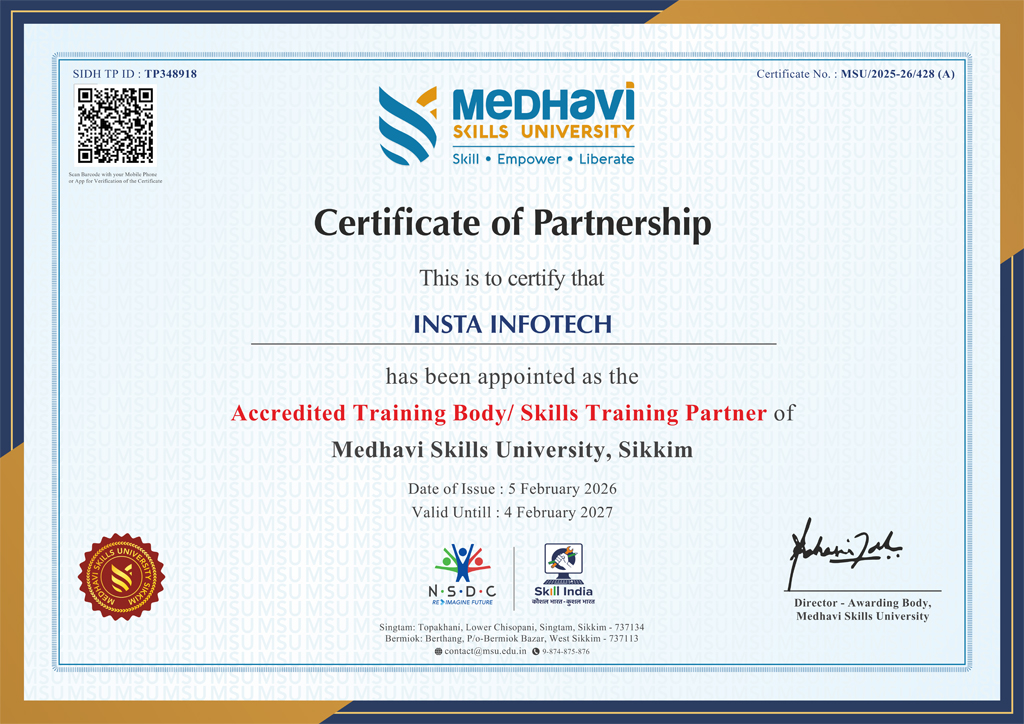
Certificate and Accreditation

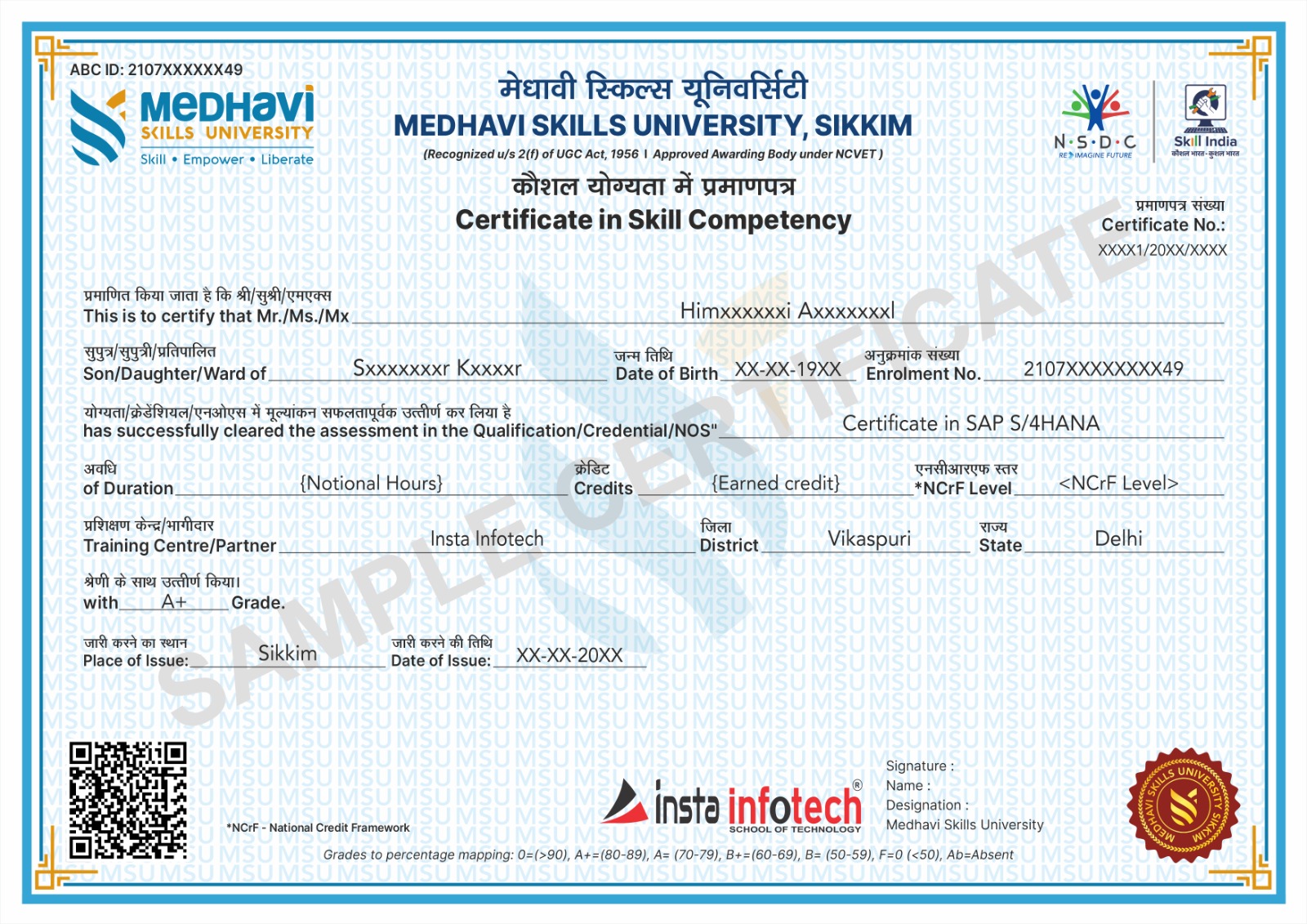
Accreditation Certificate

Professional Diploma Certificate

Skills Certificate

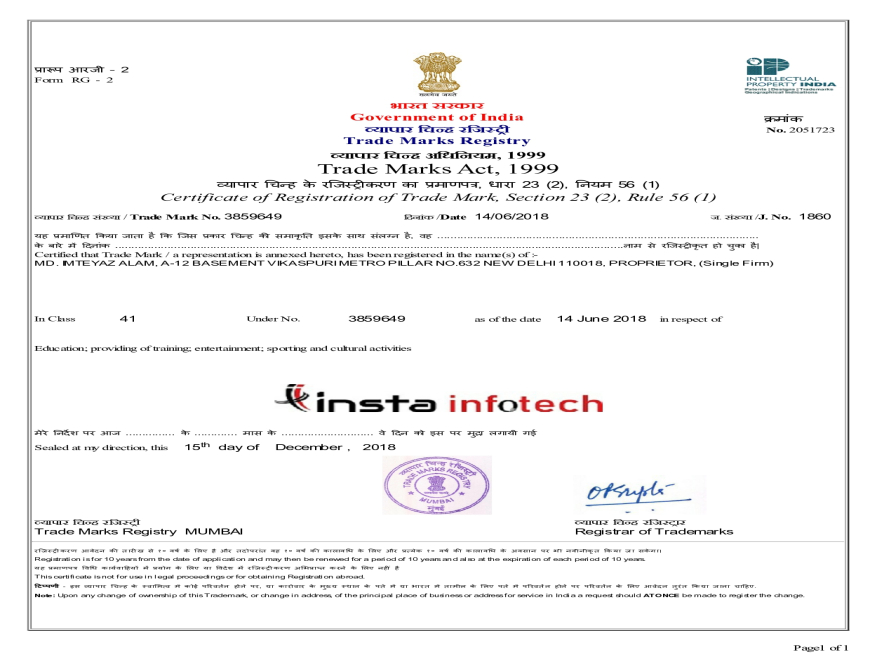
Brand Registration

Trust & Validation

UGC-Recognized Skilled Qualifications for the Modern Global Workforce

University Certification

Earn industry-relevant Certificates and Diplomas awarded by Medhavi Skills University, a UGC-recognized University. Insta Infotech is Approved Training Partner of Medhavi Skills University, ensuring quality education and credible certification.

Certificate Verification

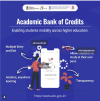
All Certificates and Diplomas are digitally verifiable through Government of India platforms, including Skill India Digital Hub (MSDE), ABC.gov.in (Ministry of Education), and DigiLocker, ensuring authenticity and nationwide recognition.

Credit-Based Course (NCrF)

Our courses are aligned with the National Credit Framework (NCrF) under the National Education Policy (NEP) 2020. Learners earn academic credits that strengthen their skill-based education profile and can be seamlessly transferred toward higher education pathways.

Global Recognition
Global Recognition

NCrF-aligned skill credits are recognized across the UK, EU, and Australian education systems. Through MSU’s global partnerships, learners benefit from dual certification opportunities and accelerated pathways to international degree programs.

Skill India Mission
Skill India Mission

Insta Infotech empowers learners with future-ready skills. Backed by the Skill India Mission and our academic partnership with Medhavi Skills University, we bridge the gap between education and employment through practical, hands-on learning and nationally recognized certifications.

Placement Support
Placement Support

Quality Skill Education — this is not merely a certificate of attendance, but a verified academic credential that enhances credibility and opens opportunities across MNCs, embassies, and government sectors.

Specializations

Skilled, Qualification, Certification

Course Credibility

Course Credibility

Our programs are certified by a recognized university, ensuring legal authenticity, academic validity, and strong professional acceptance. This means your qualification carries real value for employment, career advancement, and higher education.

Employability

Employability

Our programs combine practical training, real-world projects, and industry-relevant skills to prepare students for immediate employment. we ensure learners confidently transition from education to professional careers.

Global Standards

Global Standards

Our programs follow internationally aligned curricula and current industry requirements, ensuring learners gain globally relevant knowledge, practical competencies, and professional practices. This prepares students to adapt, compete, and work confidently.

National Alignment (Skill India)

National Alignment (Skill India)

Aligned with the Skill India Mission, we transform vocational training into a nationally recognized qualification, enabling our students to become part of India’s formal skilled workforce.

Academic Mobility (Credit-Based)

Academic Mobility (Credit-Based)

Through the National Credit Framework (NCrF), our courses are not merely extra-curricular; they are credit-earning modules that contribute directly toward your formal higher education pathway.

NEP 2020 Integration

NEP 2020 Integration

Aligned with the National Education Policy 2020, we transform traditional IT education into a multidisciplinary, skilled-based vocational pathway that enables students to earn formal academic credits.

Our Blogs

Latest Blog Updates

SEO Training Having Great Future Insta Infotech

Internet marketing is now flourishing throughout the world. The widespread use of internet has increased the market of products and services online. This has again increased the demand of online marketers.

Read More

Skillful Website with Developing Standards

If you are planning to choose a career in IT, here you find the career scope in joining Web designing course in Delhi.

Read More

Connect IT Training Peaks

Insta infotech “Software And IT Training Institute” makes an instrument to meet the twin challenges of continuous improvement in IT demand for change

Read More

Pick up High-Level Programming Language Python

Python is a High-level programming language. Python programming can be used for Data Science, Network Programming Web Development, etc. Our training covers python as object Oriented, Python as Data structure, GUI, Database connection with Python. Python is famous language as machine learning, course focus on  learning from beginning to advanced level.

Read More

Specialize in RHCSA certified Professional

Insta Infotech certified candidates with RHCSA practice course with 200+ RHEL7 real-world problem scenarios covering all the exam. An RHCSA® certification is earned when an IT professional try the core system administration skills required in Red Hat Enterprise Linux environments. To become an RHCSA certified, you need to pass the EX200 exam. Only this course has the up to date simulated tests questions, where all questions are carefully scrutinized by real Linux certified professionals.

Read More

Start Your Career As SEO Expert

Search Engine Optimization is one of the essential method you can make use of, attaining more higher rankings but also for running effective Search Engine Optimization campaigns.Today building a career in website development standards is the prime focus on all SEO methods, and also if it's not appropriately implemented. Professional and practical SEO courses in Delhi works on Live Projects that can provide you long-term gains in a shorter period.

Read More

Transform Your Career with Insta InfoTech - Premier IT Training Institute

Join Insta InfoTech for cutting-edge IT training programs designed to boost your skills and career prospects. Offering expert-led Courses in Software Development, Data Science, Cybersecurity, and more.

00+

Trained Students

00+

Years of Experience

00+

Countries Represented

00x7

Support

Insta Infotech

What We Offer

At Insta Infotech, we specialize in a wide array of courses across domains like:

Programming Languages: Java, Python, C++, .NET, and more. Data Science & Analytics: Machine Learning, AI, Big Data. Cloud Computing & DevOps: AWS, Azure, Docker, Kubernetes. Cybersecurity: Ethical Hacking, Network Security. Digital Marketing: SEO, Social Media, Content Marketing. Database Management: SQL, PL/SQL, MongoDB, Oracle.
Enquire Now
Our learners work at